Charlie Sheldon studied at Yale University (American Studies) and the University of Massachusetts (Master’s Degree in Wildlife Biology and Resource Management). He then went to sea as a commercial fisherman off New England, fishing for cod, haddock, lobster, red crab, squid, and swordfish. Active in the fight for the 200-mile Fisheries Conservation Zone, he later worked as a consultant for Fishery Management Councils, developing fishery management plans and conducting gear development projects to develop more selective fisheries. He spent 28 years working for seaports (New York, Seattle, and Bellingham) as a project and construction manager and later as an executive. In addition to overseeing habitat cleanup projects, he worked with Puget Sound Tribes establish a system whereby tribal fishing could coexist with commercial shipping in Seattle Harbor and Elliot Bay. Then, nearly ancient, he returned to sea, shipping out with the Sailor’s Union of the Pacific as an Ordinary Seaman, Able Bodied Seaman, and Bosun. Starting with commercial container vessels, on the New York to Singapore run, he finished his career aboard naval ships for Military Sealift Command. His last gig was as bosun aboard USNS Shughart, New Orleans to New York, in 2016. Always a writer, he published Fat Chance with Felony and Mayhem Press in 2005. He began working on ideas for Strong Heart long, long ago and began serious research in 2010. These days he hikes in the Olympics whenever he can, cooks for his wife, and continues to write tales in Ballard, Washington.
I wonder if we as a species are dumbing down. Before farming (ie, dense settlements, crowds, and a need for administration) human bones we have recovered shows that skeletons were stronger and brains bigger. In fact the very recent discovery of that skull in northern China, maybe 150,000 years old, has a brain bigger than modern man’s. My guess is we had bigger brains because we needed to remember everything in order to carry forth learning and culture. We did this with stories, I am sure, stories as a way to encode memory for years, then for generations.
Then with farming, and the development of a priestly class, writing developed, first used to catalogue the administration of commerce and materials, and to document religious structure and belief. Until very very recently – as in, the last say 500 years – only a tiny percentage of we humans could read and write; needed to read and write,. Then, about 400 years ago, education in the literary arts became more widespread, and now, in the 21st century, nearly everyone can read at some level.
So for the last say four or five centuries humans began to store their memories and their data with writing and scrolls and books in levels great enough to see the broad development of libraries. Libraries, and palace records, documented what had been learned and exported all this information to ink and paper such that humans did not, any longer, have to carry everything around in their head. At the same time, of course, culture and civilization became increasingly complex, requiring great specialization in the professions and in learning itself – further requiring the use of paper and ink to hold records, instructions, historical accounts.
With the wide use of reading and writing the tremendous importance of verbal and oral histories, and teachings, began to diminish. What had been held in a person’s large brain was now stored somewhere else. This meant that the brain no longer needed to remember so much. And maybe this is why the average brain of we humans today is smaller than the brains of our ancestors who had to survive in a world filled with terrible animals, great ice, and huge swings in climate.
Now we have entered a third phase in this process, in the last half century – the development of the computer, the ability to store incredible amounts of information on chips and drives. This was something in the early years but still required the printing of thousands of pages to reveal the stored data. However, in the last 20 years the “cloud” and the Internet has created a paradigm shift – now everything is stored in the “cloud” and there are applications and programs that enable anyone on earth, using a cell phone or computer, to ask any question and receive an answer. This is called “googling.” You see it all the time, someone asks a question and someone else peers at their phone and a half minute later gives an answer, because they googled the cloud and the cloud spat back an answer.
So these days humans no longer have to remember everything with stories, as our bigger brained ancestors had to, or know enough to read a card catalogue to find data in a library – no. These days all someone has to do is be able to read and click in a question, and the “cloud” gives the answer.
If human brains shrank with the advent of writing, the first form of remote storage, won’t brains shrink even more, and faster, with this “cloud?” Why exercise your brain, train it to learn and hold information, contain it and sort it, when an external thing does it for you? All those stresses and pressures creating neurons and pathways will fall idle.
When the Kennewick Man was discovered in Washington State a great argument ensued. Native tribes demanded that the bones remain with them, as an honored ancestor of 9,000 years ago. Others – non-Natives – argued the Kennewick Man carried “Western” traits (whatever the heck that means) and might have origins from Europe. A battle ensued. Along the way, of course, DNA analysis and genetic testing has evolved rapidly, such that today there are complete genomes of ancient peoples available from both the Old and New World. Recently, as the article below describes in fascinating detail, Kennewick Man has been confirmed as a true Native American ancestor, and his remains returned. It is still the strong belief, supported by evidence, that Native American peoples came from Eurasia, mainly Siberia, some 15,000 to 24,000 years ago. We have already forgotten that just two decades ago the STRONG belief was that nobody was in the Americas until the “Clovis” people appeared 12,000 years ago. As every year passes, dramatic rethinking is being forced by new finds:
Ancient people reached the Americas at least 20,000 years ago, and maybe much earlier;
Ancient peoples understood maritime seafaring and wandered widely, but during a time when sea levels were much lower such that all their sites are now covered;
Ancient patterns of trade and resource exchange were complex and widespread, often covering thousands of miles;
All during human development the climate has changed, some times rapidly, in enormous swings, equally as dramatic then as the current concerns about global warming have people panicking today;
There is now a begrudging acceptance that humans living in the time of the great animals were, for thousands of years, NOT the top predator, but barely able to linger in out of the way protected sites.
I built this theory that during the last ice age, thousands of years, even tens of thousands of years before the accepted time of crossing the land bridge ( less than 15,000 years ago), people might have been in the Americas, living along the coast, sheltering on islands in glacial refugia away from the great carnivorous animals and near fish and marine mammals for food. Because, then, people must have been few in number, and because even in our earliest days humans knew it was healthiest to find mates not directly related to family members, I think it is fair to guess that bands of raiders went out and sought to steal people from other groups. This behavior has often been documented even in recent memory, as for example knowledge that First Peoples from way north in British Columbia sailed their great canoes south to the Strait of Juan de Fuca to capture women and slaves from Puget Sound tribes living along the shores of the strait.
Evidence exists that ancient people were tremendous seafarers, surely able to leave the sight of land for fish, for travel, and while a coastline in an ice age might have long sections bounded by cliffs of ice, I speculate travel was possible, and frequent. The structure of the ice age world revealed in the Strong Heart Series is, of course, fiction, but as true as I could make it based on the research I did. It seemed to me then, and still does, it would be a lot easier to have other people capture and steal mates from inland neighbors if you could offer something of tremendous value in exchange. In my stories, I imagined that these ancient People walked south across the Great River for razor stone – they crossed the Columbia for the obsidian available in Oregon – and then they headed toward the Bering land bridge with this razor stone to trade for wives at a meeting place somewhere midway along that land bridge.
Of course this idea contradicts accepted theory on every level – my tales took place not 12,000 years ago nearly 70,000 years ago – I suggest people could navigate their great canoes 2,000 miles along an exposed coast and survive, I argue that because of the great animals humans barely survived in out of the way and hard to reach refuges, protected by ice, by water; that humans lived and even thrived all this time along the strip of shore now buried hundreds of feet beneath a rising ocean.
This tale came to me in 2012, or the first draft did, and I thought, then, God has a sense of humor, a wicked one, and as sure as I am writing this today, at some time in the near future something will be found confirming that humans have been in the Americas far longer than 15,000, or even 20,000 or 40,000 years. It better be a damn good find because everyone with careers built the current thesis will fight to the death to protect that thesis, as even now some still fight to protect the 12,000 year “Clovis” thesis, which was debunked by the finding of a spear point in a mastodon bone in Sequim, Washington that is 13,800 years old – the oldest evidence of hunting, I think, anywhere in the Americas.
But, that razor stone, and the idea a people collected that stone for use in trade for wives with other people living far, FAR away, beyond the land bridge, was not when my story first appeared ridiculous to me, and now may be even more reasonable based on the report that obsidian – razor stone – only available in Oregon, has now been found under Lake Huron, at least 9,000 years old. The age of this find fits within current dogma about the end of the ice age, but also shows that people, even back just as the ice was melting, traded materials over thousands of miles.
I think there has been a lack of imagination about how ancient humans lived and survived. In addition to missing, until recently, the awareness that throughout human history humans have persisted through enormous climatic changes (one ice age after another), we have also imagined how ancient humans lived by comparing them to the few remaining hunter gatherer societies remaining on earth. By the time human studies and anthropology and archeology came into being as specific fields of study (no earlier than 1850 and really not until around 1900) most hunter gatherer groups had been decimated by disease, encroachment, and crowding. When I was in graduate school in 1970 some papers appeared contradicting the belief that ancient human groups spent all their time foraging for food, or hunting, frequently starving, always desperate and stressed. Studies of the Kalahari Bushmen in Africa, near the Kalahari desert in Botswana, demonstrated that in fact they lived pretty well – hunting one or two days a week, gathering foods a few days a week, and spending a lot of time socializing and telling stories. Researchers were also astonished to find that, once infant and childhood deaths were accounted for, adults lived to the same age as modern humans. So the belief was either that ancient tribes struggled always, or, perhaps, actually lived a nearly suburban life.
While it may well be that ancient tribal groups lived very much as the few remaining hunter gatherers today live, what seems to be missing is that the major difference between now and then is that back then the great animals were thriving – mammoths, mastodons, and great sloths could be found nearly everywhere, as could their predators. And what predators they were – great lions larger than modern lions, huge saber tooth cats, dire wolves standing four feet at the shoulder and weighing 200 pounds, and short face bears, carnivorous bears weighing a ton, able to run 40 miles an hour, and reaching as high as 15 feet.There were big hyenas and other carrion eaters, too. In fact, attached below, a mass grave of Neanderthals was just found destroyed by what are believed to be a pack of hyenas, yet even this article misses the main point.
Where I think the lack of imagination lies is understanding how ancient humans must have responded to these animals. Humans are small, weak, and slow, though their endurance over long distances is perhaps the best of any animal on earth, and there is even one theory stating that ancients hunted big game not by attacking that game but by running it down, harrying it again and again until it collapsed with exhaustion. Whenever a human wandered the plains or forest, he or she wandered in territory used by the great predators. Yes, groups gathered together with burning firebrands might have been able to take on a pack of dire wolves, but just as surely the wolves would have had their day. Humans had to find places that were safe from these predators, and safe for long periods of time, because years were needed to raise a child to adulthood, to grow and learn what was needed for survival – at least 13-15 years, probably longer. Every time a group moved, they were vulnerable to attack. If they chose to remain in one place, say a big cave, they needed to range far and wide for game and foods, also vulnerable to attack. Life was always risky, and dangerous, and harsh, and the most dangerous elements were the great predators.
This suggests to me that early humans, all the way up to the end of this last ice age and the beginning of agriculture, must have chosen to find places to live that were, to the degree possible, isolated from easy attack yet near sufficient food for survival. The only such places I can imagine would be along the shore, the seashore or a great lake, on a nearby island, separate from the mainland but with the mainland accessible for hunts, and close, too, to marine resources such as shellfish and fish. On the mainland, such a secure place would be a cave, something with a relatively narrow entrance that could be guarded with fire and spears, but the most secure places would be nearshore islands with marine resources and access to nearby mainland game.
What does this suggest? First, that it is likely that those groups of humans living inland might often have been destroyed, again and again, over thousands of years. Second, that any groups living along the seashore on nearby islands had a better chance of long term survival, but we will never know because the places they lived, the seashore and islands, have long been buried by the rising seas as there last ice melted. And, third, and to me most important, when those groups along the shore felt the need to find new resources, they followed that shore, island to island, over the centuries, and this suggests that the first long human migrations were along coasts, not the interior.
If this is the case, and I believe it is, then throughout human history, over the many times land bridges appeared with the coming of the ice, it is highly likely that humans traversed those land bridges, including the one between Eurasia and the Americas. And, if humans lived along the shore on islands, then from their very beginnings they used boats, initially hollowed out trees to make canoes, to follow that shore wherever it led.
The first real humans, it seems, were Homo Erectus, erect man, who survived nearly two million years, maybe until nearly the present, eventually either merging with later humans or dying out (I think merging is much more likely). Slightly smaller than we humans today, with a smaller brain case, Erectus used fire and has been found in Africa, Europe, Asia, and Indonesia. Some believe Erectus used canoes. Later species, or subgroups, of humans, with larger brains, also used fire and boats. But during all this time, those two million years, in addition to over 20 ice ages coming and going, until the last 10,000 to 12,000 years those humans all shared the earth with the great predators. These great and terrible animals must have been the defining control on humans, the factor that kept the human groups small, distant, often unsuccessful. Only with the end of this last ice advance, as sea levels rose and agriculture emerged, and as the great animals became extinct, did humans overrun all the earth. But, for over 99 percent of our history, if this thesis is correct, humans were restricted to those isolated places that could be considered safe – islands, maybe even glacial refuges among the sheets off ice.
Humans arose during the last two million years, according to available fossil evidence, with so-called “modern humans” – that is, humans leaving behind evidence of culture, art, technology – emerging perhaps as recently as 70,000 years ago, or perhaps 200,000 years ago. Nobody is quite sure and a bitter argument is raging about the exact when and where, though nearly everyone agrees the first such “modern” people arose somewhere in Africa before migrating elsewhere.
This means that humans evolved coincident with the ice ages, that two million year period we call the Pleistocene within which ice has advanced and retreated on a roughly 100,000 year cycle, at least 20 times, with the most recent ice age having its “maximum” about 20,000 years ago before retreating until, maybe 12,000 years ago, the ice was mostly gone (except for some remaining caps in Canada and Eurasia). But, before that 20,000 year ago maximum, there were many rises and falls during the previous 80,000 years. It seems that even during the height of an ice age the summers could be hot, maybe as hot as today, just shorter, and of course the winters were colder. It also seems that the temperature could rise and fall over a very very short period, maybe as little as a year or two, certainly a decade. It seems likely that the way an ice age begins is not that somehow glaciers far in the north grow thicker and thicker and then march inexorably south to cover much of the land north of 40 degrees north; instead, a more likely cause is that the snows fail to melt one summer, then another, then another, until after 10 years the snow compresses to ice and after 100 years a thick glacier in place exists.
The earliest humans, as far as we know, did not farm, or grow crops. This invention, agriculture, started about 10,000 years ago, following the latest ice age, when a roughly 10,000 year period – the interglacial – began, when the weather stabilized for centuries of warmer weather. It may be, in fact I am sure it was, that humans during the ice time worked a form of “primitive” agriculture – using fire to clear underbrush so food plants could thrive, for example. The first human societies, whether modern or not, were hunter-gatherers, seeking game for meat and gathering nuts, fruits, edible plants, as well as foraging along the shore for shellfish and seafood, and of course fishing.
The ice age warm time between ice advances before the warm time we are now in occurred about 120,000 years ago. It was called the Eemian, and lasted 10,000 years. The average temperature during that interglacial was apparently warmer than even today’s warmer days, maybe as much as one or two degrees Celsius warmer, and the sea level back then was as much as 20-50 feet higher than the sea level is today. During the over 20 previous ice advances during the Pleistocene, land bridges appeared as sea levels dropped because of all the fresh water locked in ice. Sea levels dropped as much as 330 feet from sea levels today, and during the entire ice period, as the ice advanced and retreated, so did sea levels vary.
All of this serves to show that there were short periods of generally stable warm climate conditions called interglacials that lasted between 5,000 and 15,000 years (generally) with the warm period before the one we are now in – and approaching the end of according to the glacial record – happening over 100,000 years ago, maybe before the appearance of so called “modern” humans. This means that for most of human history, in fact for all of it, we lived and evolved during periods of great changes in climate, huge changes, some times happening within a year or two, and certainly within one or two lifetimes. These changes in temperature, weather, sea level, storm intensity all surely greatly influenced behavior patterns of prey animals and the location of edible plants. Along the seashore, the tide lines would rise, and fall, some times greatly, and all these changes would alter the locations and behavior of seafood clusters.
Of course, we humans have incredibly short memory spans. Who among us knows, for example, what our grandparents or great grandparents did every day to live? These days many people remember winters when the snow was much deeper, when they were children, though maybe that was because they were half their adult height. When I was a kid in the 1950s I remember vivid stories and memories of the Great Depression, seeing older men and women still carefully saving and pressing flat tin cans for reuse. Most people alive back then knew of times when electricity was scarce, even unavailable. A life without electricity today would seem unimaginable for most people alive in developed economies. Yet, a century ago, 1921, electricity was still not available for over half the U.S. population. The point here is that huge change is happening all the time these days and we forget about the change as time passes, and especially as those who lived in such different times pass on, because then instead of hearing directly from an eyewitness we hear from someone who was told by someone, and this must be the case for almost anything that happened more than 60 or 70 years ago. And, beyond that, say, back to the Civil War, the people alive then are now our great or great-great or even great-great-great grandparents, myths of imagination and memory.
So, even though during most of our history the climate has changed greatly and often, any changes occurring over, say, a century and surely over two or three centuries would not be seen in the immediate life of anyone living, not really, such that then there would be legends of warmer times, or colder times, almost myths, lost in the haze of memory and history. And this means that we humans think that what has been happening in our most recent memory – a year or several years – is what has and will always happen. We are, if nothing else, adaptive, and so we adapt, and as the climate changes, we adapt or die. We need to find new hunting grounds, or new edibles. We need to move the village because the sea now floods our shelter. The great herds upon which we depend have suddenly wandered away over newly exposed land that rose from the sea (though in fact the land emerged from the falling sea).
All of which to say, even though the climate has changed always (but changed much less during the warm times between glacial advances and retreats), within the lifetime of one person, much of the change, maybe all of it, would be impossible to see, and big changes over, say, four generations would soon be considered exaggeration or myth. What is true, though, is that the changes taking place force adaptation, learning, adjustment, flexibility, and this was surely the case everywhere on earth, even those places near the equator far from the advancing ice, because they, too, would be changing as well.
I think it was the ice ages that had much to do with making us human, maybe as much as the control of fire for the ability to build culture and learning with stories. These days many if not most among us think we face a climate crisis. What many if not most of us fail to realize is that the human condition is exactly one of adapting to climate crises, and it has always been so.
It seems we now have fossil evidence of at least 6500 individuals from ancient times; that is, older than, say, 10,000 years, and much of this evidence has appeared in the last 20 to 30 years. There is today a revolution taking place in the study of human origins. New technologies, new methods of dating, the ability to retrieve DNA from ancient bones and even from the dirt over which ancient people lived, is announced on a monthly basis, and as the new finds are reported new theories arise, are defended, some times accepted. We know today that there were several different types of ancient humans coexisting together and that these different types interbred and produced offspring. We know, for example, that many of us contain Neanderthal DNA, or Denisovian DNA. Yet, while the fossil record may reflect 6500 individuals, there are only about 200 fossil skulls that have been found, which suggests that, given all the effort and energy expended searching for human origins, the evidence is still very sparse.
There is another debate that occurs, as well, concerning when these ancient humans became “modern,” whatever that means. It seems that some versions of ancient humans were as large as humans today, with a brain case as large or larger than today, extending back at least 600,000 years. Yet evidence for modern behavior – burial of the dead, artwork, sculpture, sophisticated tool kits and technology – is generally agreed to only extend back into the past 70,000 years, although sites in Africa much older show red ochre as a possible decoration. This raises the question – what happened, then, that enabled humans to develop culture, technology, community as we understand it today; what was the incident or event that caused a being with a certain brain size and structure to suddenly begin leaving behind evidence of myth, dreams, narrative, and history?
It is agreed that hominids arose in Africa, and extended from Africa to the rest of the world, maybe in a couple of migrations, the first being Homo Erectus almost two million years ago and a latter migration much later about the same time as modern humans appeared. But the evidence is contested. Some argue the first modern humans were found in northeast Africa, others say the Middle East, there is even a find in eastern China that may be older still. There seems to be general agreement that humans crossed the sea to reach Australia 80,000 years ago, and it is also generally accepted that the western hemisphere, North and South America, was empty of hominids until the end of the most recent ice age when some humans crossed the Bering Land bridge and entered North America, either along the coast or inland once some ice had melted. There are disagreements about this, of course, with some arguing humans made it to the Americas about 14,000 years ago and others arguing humans arrived much earlier. There is a site in the Yukon, Old Crow, that may be 24,000 years old. A few argue that humans came to the Americas far earlier than that. However, there are hardly any archeological finds older than 14,000 years to support such an argument.
For decades the belief was that humans crossed the Land Bridge, then waited for a channel to melt in the two great ice sheets covering Canada, then raced south to fill the continent, killing all the great animals on the way. More recently another argument has emerged, arguing that humans first made it to the Americas by traveling the coast in boats or canoes, beach to beach or island to island, living off the marine resources and bypassing those places where the ice sheets met the sea. One big challenge with this thesis is that during the ice ages the sea level was as much as 330 feet below present day sea level, meaning any coastal communities or evidence lies buried beneath tons of water. The beach scene pictured above, Olympic National Park in northwestern Washington State, which is probably what that ancient shore looked like tens of thousands of years ago, was, back during the ice time, on a slope hundreds of feet above the beach below it.
We now know that ancient humans were capable of using boats or canoes and fishing offshore, and moving island to island. In Timor evidence of tuna fishing was found, 40,000 years old, and to catch such tuna one needs to travel beyond the sight of land.
Two factors seem to be missing from all these arguments, at least in the research I have done. The first applies to the animals among which these humans lived, and how their presence and behavior might have influenced human decisions and choices as to places to shelter. The second concerns the relationship between human behavior and movement and the frequent ice ages that swept across the top half of the world – one every 100,000 years for at least two million years.
It seems to me, at least based on the research I did about what we know and can speculate about early human groups, that while life back in the era long before farming and towns and then cities it is likely that small groups could find sufficient food – especially if living along a seashore – without working every hour of every day, leaving time for play, stories, art, and wonder, it is also the case that during nearly all of those years – any time longer than 12,000 years ago when all the great animals went extinct – humans shared their homes with large, dangerous, and carnivorous beasts: dire wolves, saber tooth cats, huge jackals and hyenas, short face bear, and cave lions, suggesting also that those small human groups had to find safe refuges to raise their young and often – perhaps nearly always – were wiped out, to a person. In that time humans were not the apex predator as they later became. Plus, and this seems often overlooked, there were huge climate shifts, glaciations, meteors striking the earth, eruptions, floods, fires, earthquakes, and tsunamis, all bringing devastation, change, and death – natural forces too great to imagine or comprehend.
It is no wonder, then, such groups were surely conservative, careful, and cautious about their actions and decisions, and even more the case that they must have been truly humble, as in, accepting their smallness in the world around them, their weakness, their ignorance about what was going on.
In fact I would imagine that, along with the ability to tell stories and carry on culture and learning, the need for humility in all things was paramount for survival. Some have written that humility – the placing of one self subordinate to other forces, the awareness of lack of knowledge and understanding, and the value of memory and ancient truth – is what creates wisdom. It is no wonder, then, that elders and ancient members of a group or tribe were revered, just as, because of the precariousness of life, attitudes were formed with a view three, five, even ten generations down the road. I have tried in my Strong Heart Series to describe such a possible culture, which still contains all the human behaviors of greed, lust, envy, and so on, and sought in my tales to suggest that the required humility of those early ages must be brought forward to the present day as a means to offset many current toxic behaviors and values.
As long as there has been writing there have been people writing of humility, in different guises, and with different definitions. Anna Katherina Schaeffer, PhD, provides an excellent summary of the history of humility:
Humility is a core value in many ancient ethical and theological frameworks. The Confucian form of humility, for example, is profoundly other oriented in spirit, consistently valuing the social good over the satisfaction of our individual aspirations. In this ancient Chinese form, humility can significantly enhance social cohesion and our sense of belonging.
The Greek philosopher Socrates held that wisdom is, above all, knowing what we don’t know. He taught an intellectual form of humility that freely acknowledges the gaps in our knowledge and that humbly seeks to address our blind spots.
Aristotle understood humility as a moral virtue, sandwiched between the vices of arrogance and moral weakness. Like Socrates, he believed that humility must include accurate self-knowledge and a generous acknowledgment of the qualities of others that avoids distortion and extremes.
An accurate understanding of our strengths and weaknesses is still a core feature of current definitions of humility. Christian humility is linked to self-abnegation, shame, and sin and may therefore not be to everyone’s taste. However, the ancient theologians can still help us to avoid arrogance and pretentiousness. They remind us that we are members of a species that is far from perfect and urge us to be mindful of the limited role we each have to play in the fate of humanity as a whole.
Through the centuries, the importance of humility as a moral character virtue has faded. However, psychological studies of humility have surged in the last two decades (Worthington, Davis, & Hook, 2017). This renewed interest in humility is, in no small part, a counter-reaction to what the authors of The Narcissism Epidemic, Jean Twenge and W. Keith Campbell (2009), have described as our “age of entitlement.
Today, self-realization and enhancing our self-worth are our highest aspirations. Precisely because it provides an antidote to many worrying tendencies of our age, such as arrogance, greed, and self-centeredness (all of which also have devastating consequences for our democracies and our planet), humility is experiencing a much-needed revival.
The first step in becoming humble, in recognizing what we don’t know and cannot control, is seeing our own true hand in a situation. Until we do that, solutions cannot be found. These are the dog days of summer…..
Fire, everywhere. Greece, the United States, Canada, Siberia, Australia. I don’t know about other places, but a strong argument can be made that the terrible fires in the U.S. are largely caused by decades of fire suppression (Smokey the Bear) allowing the build up of huge masses of tinder, not to mention building neighborhoods in areas sure to burn. Yes, the beetle infestation is a factor, and hot and dry summers, but we own a big part of this.
Covid Delta wave: We had it licked in the late spring, or so it seemed. Vaccines (three of them) that worked and many people wearing masks in crowded spaces. Now, three months later, it’s almost as bad as before, this time nearly all people who have not yet been vaccinated. How can it be that we have become stupid enough to politicize the health benefits of masks and vaccines, to somehow make this an issue of freedom instead of health? We have entirely forgotten the world before penicillin and vaccines, when life was cheap, many died, and people grasped at the chance to take a shot and protect themselves. They would look at us today and laugh. How did we beat polio? Everyone was vaccinated, end of story. Good God. Yet here we are with millions among us refusing to face the situation, in denial, pretending the virus itself is fake.
Afghanistan: Twenty years of war and the army we built and funded collapsed in two weeks. Somehow our initial limited mission to get Bin Laden and Al Queda morphed into something else, nation building. And then, when the Iraq invasion propaganda was in full swing, just before the invasion, millions around the world marched against war. No media mentions that today, those millions who were right, back then, and still are. Our history of invading other countries to remake them in some idealized democratic system is a terrible history, and we have learned nothing, it seems. Two Presidents could not end what Bush began. Now Biden has ended it and the media and pundits are howling. Tough break for the war industry, for sure, but a blessing to any parent of any kid in the services. And who do the media bring on to discuss Afghanistan? The very same people who howled for invading Iraq, remaking the Middle East, nearly all in some way connected to military contractors and think tanks.
A humble person faces facts, admits error, and learns from mistakes. Repeating the same mistake expecting a different outcome is a good definition of insanity. It seems we are close. We have been allowing the forests to fill with tinder for two or three generations. In the face of compelling evidence we still, or many among us, refuse to take simple, tested, proven health steps to defeat this virus. Despite, in my lifetime, having now twice invaded and tried to remake another nation, stayed way too long, and been entirely defeated, there are many in the Washington D.C. blob seemingly arguing that leaving Afghanistan is a mistake, and it seems these people are the ones filling all the air time.
I don’t see our leaders in the forestry industry howling and demanding funds to clear the tinder from forests, to allow controlled regular burns, to prevent construction in fire prone areas. I do see some among us demanding vaccine and mask requirements, but this could have been so easily handled had the last President said everyone needs a shot and a mask, again and again, starting in early 2020, but he did not and here we are. Finally a President came before the public and said Afghanistan was lost, and to protect American lives we were leaving, and the leaving would be difficult and messy, and the buck stops with him as to the outcome, and he has been vilified. Yet, to date, he seems the first among us to show some humility.
I hope we see more.
Humility (2)
During the last, say 150 years there has been unrelenting and consistent technological change in nearly all areas – medicine, communications, travel, energy, the list is seemingly endless. It is almost unbelievable, actually. Somehow there seems to have been a parallel assumption that we humans have also changed greatly, maybe because we think we must have changed to bring forth all these marvels, and maybe, even more, many of us think that with all these new wonderful tools the measure of people, their character and behavior, must be changing rapidly as well. There has been, for at least six or seven generations, a steady belief in inevitable progress in all areas, including the character and behavior of humans.
This is a huge, huge mistake, in my opinion, because human nature hasn’t changed despite all these technological breakthroughs. The evidence of our own eyes and memories, for those of us who have been around for eight or nine decades, is exactly the opposite, as is the historical record – we humans have been bad to each other, always and forever.
Go way back, Im mean, way way back, before farming, before towns and cities, the time of great ice and terrible animals, and humans barely hanging on in remote safe places. When a group invaded another group’s territory, back then, it seems they captured the women and children but killed off all the men, all of them, so there would not be retribution. Surely humans then, and in the years since, and today, are selfish, vengeful, hateful, lustful, cruel, possessive acquisitive, tyrants, murderers, just as humans are loving, caring, friendly, empathetic, self sacrificing, and noble.
Look over the last 150 years – many huge wars, hundreds of millions dead, maybe 70 million in the two World Wars alone. Millions more killed with famine, whether in China, Russia, India, Asia, or elsewhere. Millions more lost to disease. Remember that a century ago only smallpox had been defeated, there remained the scourge of measles, mumps, whooping cough, scarlet fever, polio, rickets, cholera, not to mention millions more lost to raw poverty. Yes, it is true that today millions of people are living far better than their forebears, but does this mean human nature has changed? That the legacy of grim news that has underpinned all the technological triumphs will somehow miraculously end?
I think not. Somewhere in the rush to greatness, and the ability to build and invent great things, we seem to have entirely lost awareness that we are both good and evil, flawed and noble, and any excess – ANY – promises difficulty, death, destruction. Nowadays we may look back and consider earlier people cautious, conservative in behavior, keeping their heads down, but maybe the truth of the matter was they were raised humble, cautious, well aware of their own dark side, and the dark sides of others. Throughout all of history the battles have remained the same – on the one had wresting survival from a hostile world, which we humans successfully did such that the world seems now to be ours, but on the other hand always, since the beginning, struggling with the much larger danger – ourselves, our conflicts and fights, and these days our narrative driven views that only we are right and all others not only flawed but even evil.
In ancient times, when we were not the apex predator, the world was above us, more powerful, and we were careful, humble, cautious, because we had to be. Now we rule the world, but it has not been the world that has brought evil, it is ourselves, plain as day, brought forth in the urgency of ideology and zealotry and certain-ness, and further complicated because the public megaphones respond to only anger, rage, froth. My sense is the greater mass of us are sick of all of it, and want to just get on with our lives, as best we can, and all of us know that only through humility will come the wisdom to regain some kind of balance.
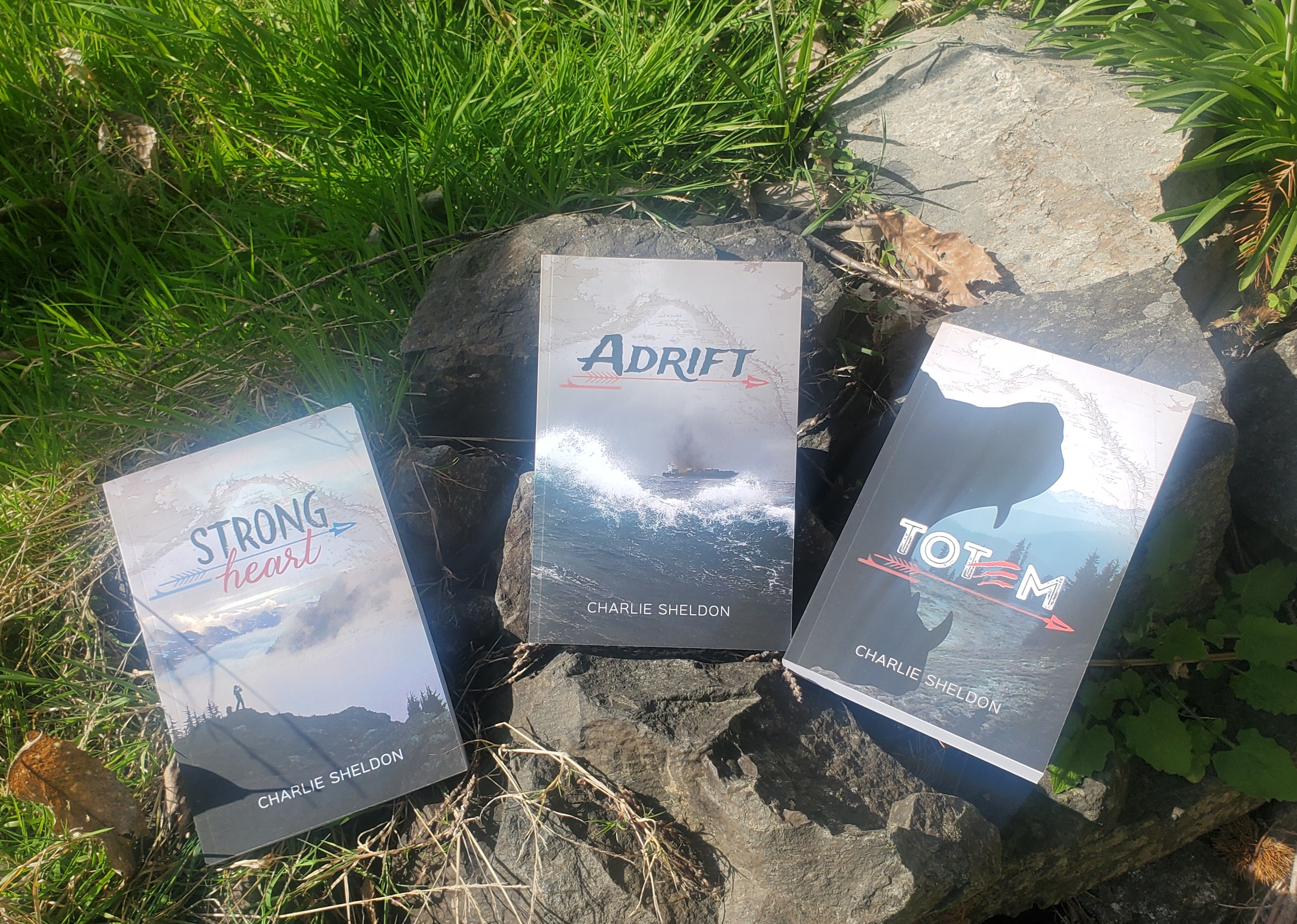
Kirkus Reviews: “In this gripping conclusion to Sheldon’s Strong Heart series, uncanny events occur after a mining operation is planned in the wilderness of the Pacific Northwest. In Strong Heart (2017), surly teen Sarah Cooley arrived on Washington’s Olympic Peninsula with a steadfast loathing of the “boonies” but gained a near-mystical connection with the wilderness. In this final book in the trilogy, Sarah, who’s now 14, is intent on returning to the peninsula at the very moment that Buckhorn Industries are about to begin extracting erbium, a trace mineral which the company claims can detoxify coal emissions. The mining operation will affect the lives of everyone on the peninsula, including William Williams, a Haida merchant sailor, who took center stage in Adrift (2018), the second book of the series, and his daughter Myra, a tribal archaeologist. The narrative also follows Victoria Oldsea, an environmental project manager at Buckhorn, and Carl Larsen, who, accompanied by his niece Laurie, is investigating the appearance of grisly elk kills in the vicinity. Sarah and her friends are intent on boycotting the mining operation, but when Victoria spots what appears to be a black saber-toothed tiger, it becomes clear that other, strange events are afoot. A terrible windstorm brings additional chaos, and as those on the peninsula begin to experience unnerving visions, the veil among reality, history, and the spirit world seems to grow gossamer thin. The series accelerates toward an exhilarating conclusion as Sarah strives to protect the beguiling landscape. Readers who are familiar with Sheldon’s writing will already know that descriptions of backwoods hiking often form the backbone of his Strong Heart narratives. In this latest offering, he again succeeds in evoking a clear sense of walking in nature: “The trail was easy. We were on an old road, rising steadily, following the river. We crossed a bridge high over a creek, the water boiling from the snowmelt.” The complexity of the novel springs from the author’s deft handling of a broad range of psychologically distinct characters and the skillful synthesis of key thematic elements, such as environmentalism, spirituality, and elements of Indigenous history. The latter’s intersection inspires stirringly poetic passages that add welcome texture to Sheldon’s minimalist prose, which otherwise remains direct and unadorned in style: “The meadows were a rich red from the summer’s dying, flowers burning their spirit. We walked through fields of blood, passing groups of trees, ledges of rock, pockets of snow.” Newcomers to the series may struggle to get a fix on the various characters at first, but this book can still be effectively read as a stand-alone work. Those who have been impatiently awaiting a denouement to the series will enjoy the gratifyingly intricate route that the author follows as he employs new and familiar characters. Overall, Sheldon has written an undeniable page-turner that’s full of intrigue and peril, as well as an emotive love letter to the natural wonder of the Pacific Northwest and its people. An engaging and thoughtfully conceived finale to an impressive series.”
Author Katherine D. Graham: “In a masterful work combining historical fiction with a touch of fantasy/mythology, Sheldon’s newest epic novel Totem beautifully marries the best aspects of time travel and reincarnation tropes with modern-day real-life stakes. Sarah is a troubled teenager whom grief has plagued, and is set up to continue that unlucky lot into the newest (third) volume of Sheldon’s Strong Heart series. Having not read the prior two volumes, I can happily say that no prior knowledge of the series was needed for me to be drawn into and captivated by this book. I should also point out, in fairness, that while the 500+ page count is daunting at first glance, Sheldon has written Totem in “books” within the book itself (similarly to J.R.R. Tolkien’s Lord of the Rings books, where multiple “volumes” are housed within one cover). This read is a fast, page-turning read that doesn’t let you go even with the historical and political backstory woven in, so the 500+ pages goes by fairly quickly Partially due to its length, and partiall due to tragedy, there is a heavy turnover of characters in Totem. As this is a spoiler-free review I won’t go into too much detail, but suffice it to say that loved ones are not guaranteed fulfilled lives or happily-ever-afters in all cases in this book (though some are happier than others). The twists and thrills of surviving in the wild are some of the most exhilarating moments of this read, and the chapters where we experience life in the past are truly magical and captivating in a way usually reserved more for epic fantasy than for historical fiction. It is truly as though we are there with the characters throughout their journeys… I highly recommend this series to anyone interested in reading a respectful historical fiction that handles First Peoples’ legends and traditions with pride and care, while keeping the stories relevant to the struggles of modern day society (history repeats itself, but can we do better). A superb job to Sheldon!”
Strong Heart: An ornery 13 year old girl appears at Tom Olsen’s door and announces she is his granddaughter. Tom and his friends take her with them on a camping trip because she has nowhere else to go. She hates it. They hate her. She sees something. They don’t believe her. Then she disappears…..
…a beautiful and heart-warming story…
…fabulously plotted…
…this book gripped me and would not let go…
…this is a must read for everybody…
…the perfect blend of the deep-rooted legends and harsh realities of life…”
…I would recommend this book to anyone…
…it’s as if you are immersed in the story….
…one of the most incredible fiction novel I have ever read…
…if you are an adventure lover, this will make a wonderful read…
…this is a must read book…
…makes me wish I had listened to stories my great-grandfather and grandparents told a little more closely…
…if you are into folklore, dreams and magic, this book is a definite must read…
…a fictional story of learning about one’s past heritage and how that knowledge can assist us in our lives today…
…themes…so universal that I believe they will speak to any reader of any age…
…if you are looking for a story with suspense then this is the book for you…
…this unique story is a book of fiction, or is it? It is similar to science fiction or fantasy, the difference being that this story just might have actually happened. Is it the author’s vivid imagination, or is it based on actual data?… Mr. Sheldon’s ability to describe scenes makes one think he vividly sees them in his mind and then is able to translate those pictures into words. I was able to visualize what was happening to Sarah, where she went, what happened to her on the way, in a way I have not experienced before. The beauty of Alaska and the Pacific Northwest comes to life on the pages…
…absorbing…alternates constantly between the past and the present and before long you lose yourself in a beautiful world with beautiful people whose experiences you joyfully share. You go through pain, anger and even helplessness with the characters…..
…the simplicity of the writing makes it for an easy read, and the charts and landmarks noted in the first few pages gives the story an authentic feel and helps you as the reader to understand the layout and journey that was taken. It is not only a voyage and adventure, but also a building of character and the display of our most basic and ferocious instincts; survival and procreation. We all want to live the best lives we can and leave something behind for the generations to follow by which they can commemorate us and remember us by. Be it in drawings, skills or just legends and stories told around a warm campfire…”
…more than a wilderness adventure, the book is good in bringing out the value of traditional knowledge in a world where scientific facts sometimes overshadow reality itself…
Adrift
Strong Heart took readers deep into the storied wilderness of the Pacific Northwest. In Adrift, Sheldon, a veteran of the sea himself, carries the story into a beautiful, brutal frontier of ice, wind, slicing cold, roiling waves, and ancient, mystic faith.
“Thank you for writing such a wonderful story. Makes a person think about how we all came to be here and our first peoples. Anything is possible with his our earth seasons change. I loved the flow of his it read, the history. Loved this book. I would say it’s an amazing, awesome read and anyone would enjoy it. There wasn’t anything I didn’t like. I will enjoy reading this again. A new favorite to add to my collection. Sheldon is a great writer. Keep them coming and I will keep reading. Your added to my favorite Authors. Thank you for a wonderful book.”
“Life is a grand story…this slice of grit and love is amazing! Adrift is about life challenges. Family, friends, tribes, and businesses clash with all their forces as people face fire, snow, ragging waters, loss, and picking up the pieces of all that life can deal. It holds out a hand to those searching for grit to hold on and hope beyond what we can logically see. It reminds us all our stories are precious, and they best told roundabouts with friends. Adrift invites all to great adventure!”
My publisher put up this great video showing how you can make a spear thrower usimg only natural materials. Worth watching to the end to get a sense of the great power thrown darts contain…..


 STORIES MADE US HUMAN
