Been a while. Been busy.

The only purpose for this little site is that is serves as a record of sorts for certain ideas, stories, or comments. I have learned that a site like this needs attention, needs material, needs tending, all of which I fail to do. Mostly though this site is about the telling of tales. So I will record here a brief report on something in progress, just for the record.

In 2010 I started doing research about this story set in the Olympics. Did that for three years, then took a writing class at UW to prove I was serious and the very first time we met the teacher, even before we introduced ourselves, had us all do a ten minute writing session. The bit I wrote then became almost word for the word the start of this tale Strong Heart which I finished a rough draft of in between gigs on ships at sea working 2013-2014. Then in the spring of 2014 I was in Cleveland working there on a shipping thing with the Port of Cleveland and I wrote a second tale, an extension of the first, Adrift. Then in 2015 I was back on a ship in Baltimore and I ended up writing a third tale there, Found, but it wasn’t quite done and at that time I wasn’t sure, had this become a long series or was this a three-book series?

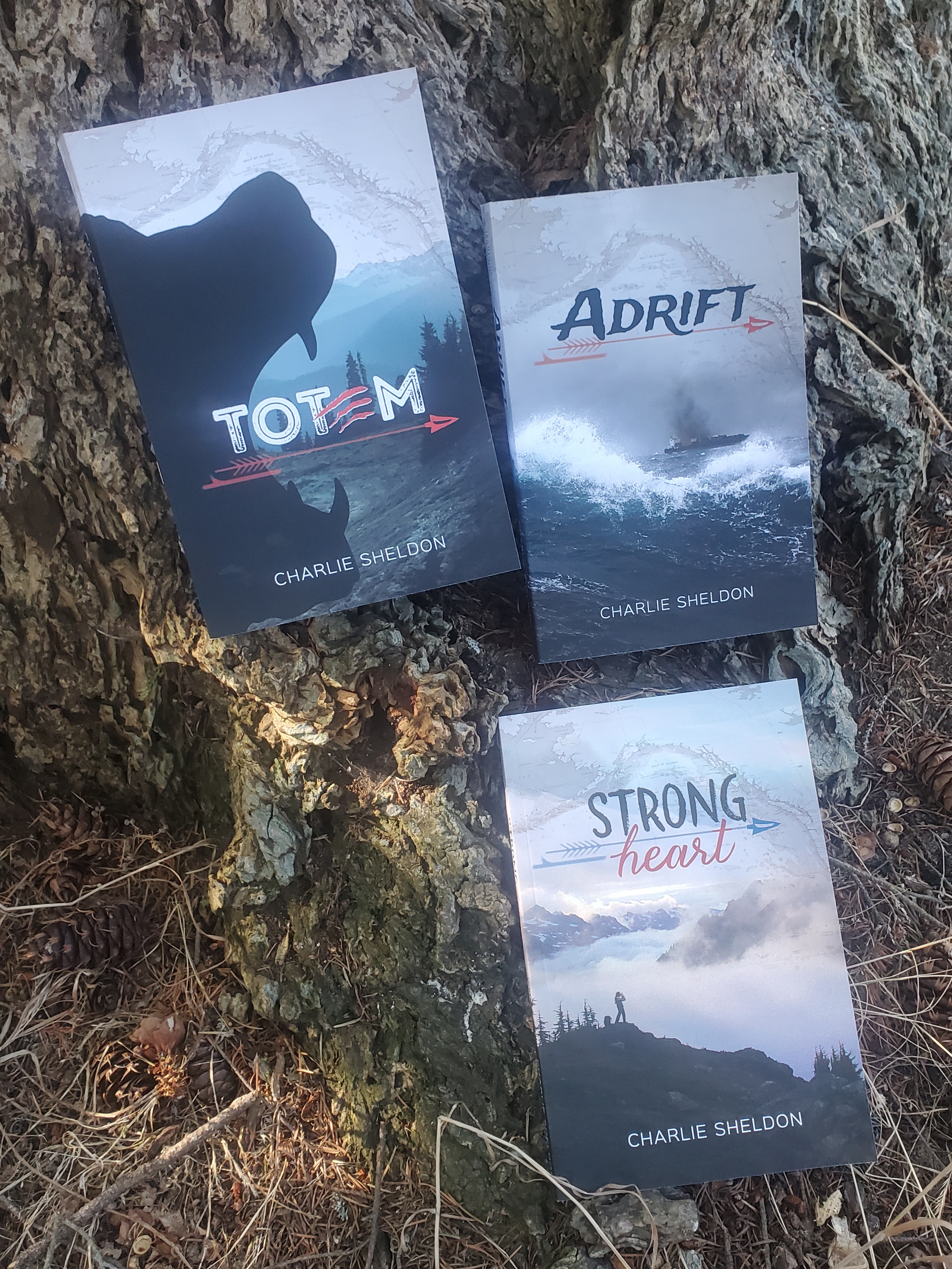
In 2016 when I got back from my last ship and retired I miraculously found a publisher, a start-up person who believed in the tales, and they were published in 2017, 2018 and then the third in 2021, by then titled Totem and added to nearly another full book length. I had some in bookstores, had a lot of readership with the Online Book Club, all over the world, and felt then, and still feel, those were as good as I could make them and readers seem to really like them. They are set in the Olympics, the British Columbia and Alaska coast, and tell stories of the present day and the very very ancient past. The books have a touch of magic realism, maybe more than a touch.

In 2019 I had just finished Totem, it was with an editor, and I had always had these notions of trying something different, not more of the series, and series can be traps, by the way. The first book I ever published with Pocketbooks in 1990 Fat Chance was bought I think in hopes it would become a series and I refused, being an idiot, wanting to write more than a simple caper, and I did, but my agent eventually fired me and then there were years in the horror of self publishing and chasing editors and agents and publishers, and I thought I was done by 2005, plus I was too busy with this demanding job with a port, but later the whispers began and then the research and so the Strong Heart series emerged. It didn’t start out that way, but that’s what happened. Anyway in 2019 I was noodling, even then, something more along the science fiction line, but not seriously, and then this friend of mine, an Olympic rower with a 1956 gold medal, someone I had rowed with with the Ancient Mariners Rowing Club out of Seattle 1990-2010, he asked me to write him a book about his experiences winning that medal with a Canadian four-man crew. It is a fantastic story, one of the greatest rowing stories there ever has been, and I jumped at it but said, because you and your guys are Canadian and I am not I want to be sure nobody up there is telling the same story, and he thought not, but a week later we learned that indeed, a Canadian, good writer, was interviewing the Canadians. By then though I was a bit into it with Walter, had interviewed him, and then I had this idea I could write about other old Olympians from that era, other gold medal winners, like the Yale 1956 crew and an American 1956 pair and the 1964 Vesper boat club. All the spring of 2019 and later, as covid crept into the world, I spoke with over 25 grand old men of rowing, the real lions, who were generous with their time, but there was this other book supposedly coming out from Canada on the Canadian four so the entire thing kind of fell apart.

I ended up with a 220 page document all these great and not well known voices from the 1950s and 1960s, just a great series of tales, but in the end nothing happened, I did not pursue it. That Canadian book by that Canadian author has not yet appeared and I doubt it will. Most of those wonderful old lions are now dead.

Then after covid ended, rowing book a bust, my series out there and getting great reviews but not great on sales, and finding myself a horrible self-promoter and becoming aware that the real business of writing is, for 98 percent of writers, shoveling money at this scheme and that in hopes of sales, all scams, all a total waste of time, you can spend every penny you have and nothing will happen. In the end, my view anyway, there has to be the rare circumstance of people in the industry with pull who notice you, luck and timing, and even then unless you write something good, forget it.

So then I spent a year, and am still working on this, a bit, chasing a colonial legend about the Deerfield massacre of 1704, because my ten times great grandfather was in that raid and my nine times great grandfather was one of those captured and taken to Canada. There have been many books about this subject, all about this raid and the capture of over 100 people and how several, including the daughter of the minister, chose to remain with the Mohawks up there to the shock of the Deerfield people. There is a persistent tale and rumor, first documented about 1820, and prevalent in the 1850s, that the reason one group of the raiding Indians came to Deerfield was not to take people but to retrieve a bell ordered for their church but taken by privateers and ending up in Deerfield. This is a deeply held view and oral tale among the tribe. I know this because in 1970, 56 years ago, I talked at length with one Ernie Benedict, an elder there and former leader, who swore the legend was true, and to this day there lies a bell in St Regis and Caughnawaga Quebec called the Deerfield Bell.

This legend is hotly disputed by all serious study people and all records of it are limited to the bell itself and the oral legend. The possible source of the legend is however the great grandson of that captured girl, Eleazer Williams, he may be a flim flam man and inventive, telling the story in the 1820s, but maybe he was passing down oral family history.

There is one last place to look to trace this story to the end, and I am doing so. Hopes are not high, but hope there is. So this effort, this research project, this took another year, and, again, nothing, not even a manuscript.

All this time noodling a science fiction tale. And perhaps something not tied to the series from before but from it, linked, somehow, in a mysterious way, not an extension of the series but clearly with people from the same family, the same area.

Then the Port Townsend Writers Conference and Centrum offer this year long novel workshop, not cheap, but hosted by Jon Evison who is a highly regarded PNW author and one of the few people I can name who is raising a whole family while writing fiction, a near miracle, and so I thought, if I sign up for this and am accepted I am forcing myself to get serious about this new tale, just as that writing course I took in 2012 started me on Strong Heart.

This series and workshop started last July at Port Townsend, a dozen of us, all more serious writers than I, most already published, a few, no more than a few brilliant writers in all ways, and every month twice a month we do these very long zooms working through parts of our books and Jon brings in other writers and it is just fantastic.

I am certainly among the least efficient writers in the world, but I am persistent, and so I started trying to write something in June and the workshop started and I wrote and by September I had 70,000 words written, that is a decent sized novel, and then I bagged the entire thing because I was trapped, mired, in backstory, unable to break free and TELL THE DAMN story. Of course, I, like many, write my way into a tale so until the characters get real nothing much can happen, then they take the story themselves, and all that writing I did was of course not wasted, this built me the world view and the families.

In late September I started again, a new start, still in the near future, still linked to backstory, and got 20,000 words into that and then by Halloween bagged that, too. Now I am 90,000 words written and all of it trashed.

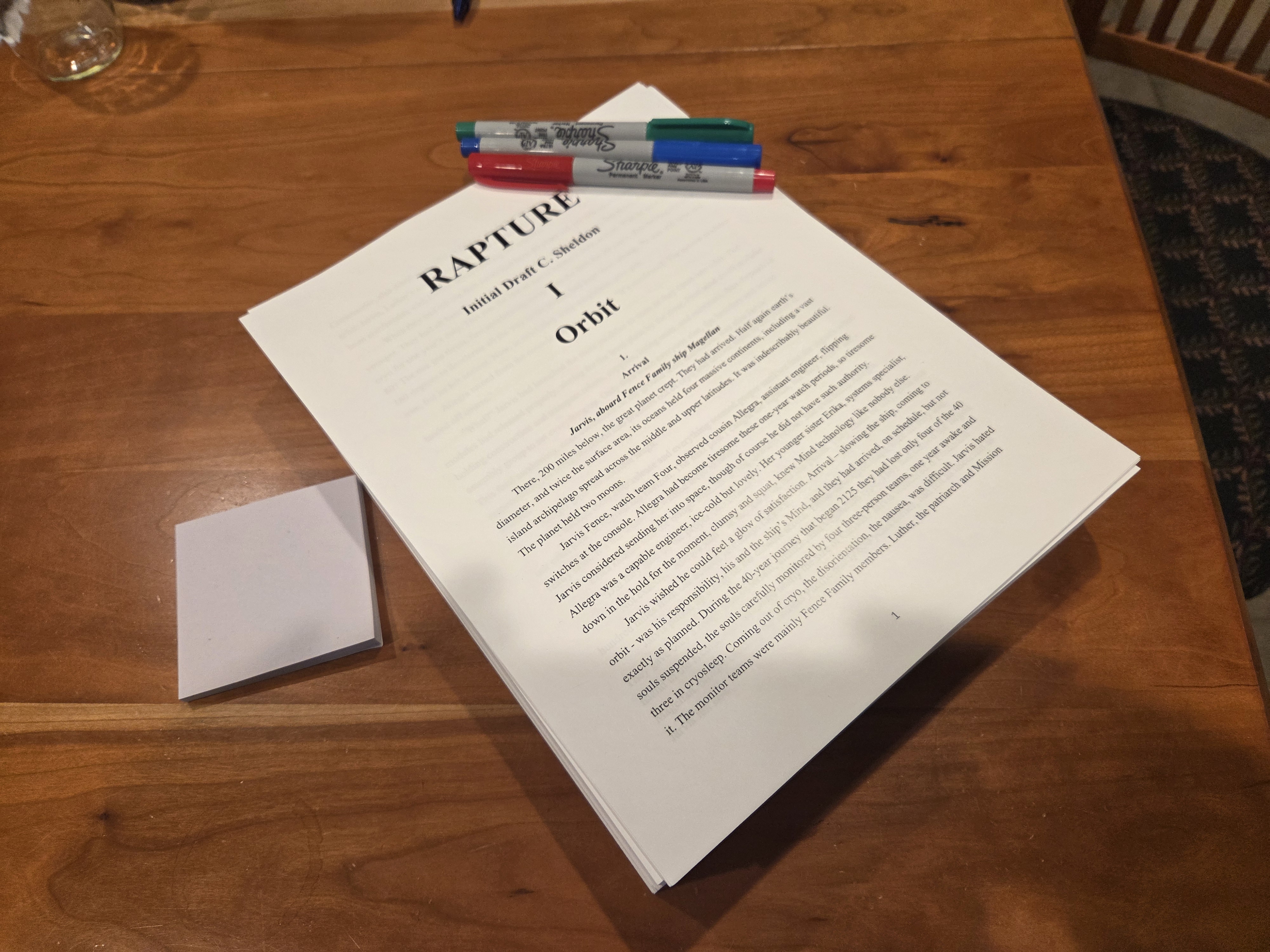
Finally, early November, I take the leap and say to myself, f**k the backstory, just start the damn story, and so I do, on a ship approaching a planet 11 light years from earth, a planet unknown, with another ship close behind, a planet in an ice age, with some evidence of sentient beings on the surface, with misplaced habitat pods parachuted into the foothills, and, lastly, a stowaway aboard. This first chapter really had a good reaction from the fellow workshoppers, and me, too, so I persisted, and persisted, and this weekend to my amazement and astonishment came to that special place in any novel one hopes for and fears will never arrive – the completion of the first full story draft, the whole tale, start to end, of course needing revision and editing and changes and rearranging, always, but still, I have a stack of 380 one and a half spaced pages, 133,500 words, there it is in the picture, clean, fresh, awating the pen, the overwriting, the work.

I have this draft, which is pretty clean and has been thought through and adjusted as I have gone, now before five early beta readers, that is people who I know who have agreed to take a look at the whole thing in this state for general reading, is it readable, enjoyable, do you keep on with it?

Funny thing, too, once the draft is done and printed, sitting there as a three inch high stack of paper, fresh, clean, demanding ink, all of a sudden all these other things flow into my mind – this is a complex, detailed, many point of view story, we have basically four different story lines weaving together, and I see the value of a list of all the characters, and their relationship, I see maps – maps!!! – of this new world and the earth; I see a family tree line showing all the people in this one family that became very rich and sent a ship away and their alienated and poor Peninsula and tribal cousins who now get all mingled together on this new planet Rapture. And of course to make all this work there needs to be not only a world view but a consistent and valid series of assumptions or real truths about life, DNA, evolution, planetary composition, habitat, and space travel as well.

So, long way of saying, after writing that series I never thought to write, remember I pretty much gave up on this writing horror in 2005, and that is now 21 years ago, now a three book series and two failed books – oh and not to mention I spent the first half of 2025 with an economist grad school friend designing a Federal Budget that would solve our deficit problem, save social security forever, put people to work, and set up up financially for decades, an offering I then tried to get to congress members in Washington and elsewhere with little impact, because I am a retired old boomer, but it was a try, anyway – that picture of that first rough manuscript is affirmation of persistence and hanging in there no matter what.

We shall see….lots of work still to do. Lots.
A Budget Approach That Works

How to solve the fiscal crisis and avoid financial catastrophe – a common-sense, practical nonpartisan approach that will actually WORK!

The Unity Plan: A Citizen-Driven Call for Fiscal Stability
April 29, 2025 | Charlie Sheldon, Tacoma, WA (toklatcharlie@gmail.com)

The Unity Plan, a citizen-driven proposal presented to Rep. Emily Randall’s office on April 28, 2025, seeks to counter the House Plan’s fiscal recklessness (216% Debt-to-GDP by 2050, $3.482T deficit in 2026, CBO) by projecting a balanced budget by 2054, 87% Debt-to-GDP, 174M jobs, and Social Security solvency for 50–75 years, shielding 89% of taxpayers from tariff shocks ($3,998/household, Treasury). It urgently requests CBO analysis to validate these projections.

Key Features (2026, Projected):

  • Revenue ($3.696T): 40% top tax rate (+$112B), $50K itemized deduction cap (+$150B), $75K standard deduction (-$786B), 25% corporate tax (+$200B), $520K Social Security cap (+$120B). No tariffs ($0).
  • Spending ($6.44725T): Hold discretionary spending to 2.6% growth ($65.1B savings), $100B Medicare efficiencies ($50B drugs, $50B fraud), $150B IRS tax gap recovery, $3T infrastructure via off-budget Unity Bonds ($60B start).
  • Outcomes: $2.75125T deficit, 127% Debt-to-GDP, 165.1M jobs.

Long-Term Projections (Pending CBO Review):

  • 2050: $0.4T deficit, 87% Debt-to-GDP, $77.3T debt, 174M jobs.
  • 2054: Balanced budget, $0.3T surplus.
  • Social Security: Solvent for 50–75 years (SSA).
  • Option: 1.6% Financial Transactions Tax (+$30B/year) could balance by 2053, reduce debt to $74.7T.

Why It Matters: Unlike the House Plan’s perpetual deficits and elite tax cuts, the Unity Plan aims to rebuild infrastructure, boost middle-class cash ($2,000–$10,000/year), and avoid fiscal collapse, pending CBO validation to confirm its bipartisan appeal (Treasury, SSA).

Call to Action: Urge Congress to request CBO analysis of the Unity Plan. Contact Rep. Emily Randall’s D.C. office (202-225-7761) or CRFB (info@crfb.org) to champion this Tacoma-led solution.

Request for Congressional Budget Office Analysis: Unity Plan (No Tariffs, 40%)

April 29, 2025 | Citizen Proposal by Charlie Sheldon, Tacoma, WA (toklatcharlie@gmail.com)

1. Introduction and Purpose

The Unity Plan (No Tariffs, 40%), presented to Rep. Emily Randall’s office on April 28, 2025, is a citizen-driven proposal to address the fiscal challenges posed by the House Budget Plan, which the Congressional Budget Office (CBO) projects will yield a 216% Debt-to-GDP ratio by 2050 and a $3.482T deficit in 2026 (CBO, 2025, p. 54). The Unity Plan projects balancing the federal budget by 2054, achieving a $0.3T surplus by 2055, reducing Debt-to-GDP from 127% (2026) to 87% (2050), creating 174M jobs, and ensuring Social Security solvency for 50–75 years, while shielding 89% of taxpayers from tariff shocks ($3,998/household, Treasury, 2025). This document requests CBO analysis to validate these projections, comparing them to the House Plan’s outcomes. It details 2026 fiscal impacts, long-term projections (2030–2050), an optional Financial Transactions Tax (FTT) scenario, implementation mechanics, and sensitivity analyses, using methodologies from CBO, Treasury, and Social Security Administration (SSA) reports.

The Unity Plan excludes tariff revenue ($0), relying on progressive tax reforms (40% top rate, $520K Social Security cap), spending restraint (2.6% discretionary growth), and efficiencies ($315.1B/year by 2027). It proposes $3T in off-budget infrastructure bonds to rebuild roads, housing, and communications, creating 3M jobs by 2050. This request seeks CBO’s expertise to assess revenue, spending, deficits, debt, jobs, and Social Security solvency, ensuring the plan’s viability as a bipartisan alternative to the House Plan’s unsustainable trajectory.

2. Fiscal Impacts for 2026

The Unity Plan’s 2026 projections are based on CBO’s 2025–2035 baseline (CBO, 2025, p. 12), adjusted for proposed policies. All figures are in trillions (T) or billions (B) of 2025 dollars, with methodologies aligned with CBO and Treasury standards.

2.1 Revenue ($3.696T)

  • Individual Income Taxes: $1.626T
    • Baseline: $1.3T (2025, scaled at 4.4% nominal growth, CBO p. 12).
    • Adjustments: +$112B (40% top rate on $3.8T above $695K, CBO p. 45), +$150B ($50K itemized deduction cap, CBO p. 48), -$786B ($75K standard deduction for 130M filers, CBO p. 45).
    • Formula: $1.3T × 1.044 + $112B + $150B – $786B.
  • Corporate Taxes: $0.5T
    • Baseline: $0.3T (CBO p. 12).
    • Adjustment: +$200B (25% rate on $5T taxable income, CBO p. 12).
  • Payroll Taxes: $1.48T
    • Baseline: $1.36T (CBO p. 12).
    • Adjustment: +$120B (12.4% Social Security tax to $520K cap, SSA p. 106).
  • Other Taxes: $0.09T
    • Excise and estate taxes, no tariffs ($0, CBO p. 12).

2.2 Spending ($6.44725T)

  • Mandatory Spending: $4.068T
    • Social Security: $1.37T (CBO p. 54).
    • Medicare: $0.96T (baseline $1.01T – $50B phased efficiency: $25B drug negotiations, $25B fraud recapture, CBO p. 68).
    • Other: $1.738T (CBO p. 54, scaled at 4.4%).
  • Discretionary Spending: $1.811T
    • Defense: $871B (baseline $849.8B × 1.026, saves $12.7B vs. 4.1% growth, CBO p. 54).
    • Non-Defense: $940B (baseline $1.942T × 1.026 ÷ 2, saves $52.4B vs. 5.3% growth, CBO p. 54).
  • Net Interest: $0.53325T
    • $35T debt × 2.5% average interest rate (CBO p. 14).
  • Infrastructure: $60B
    • Off-budget Unity Bonds, ramping to $200B/year by 2028 (Treasury, 2025).
  • Enforcement: $2.5B
    • $5B phased for IRS and Medicare fraud staff (~25,000 at $100K/year, CBO p. 52).
  • Inflation Adjustment: $32.5B
    • 0.5% on $6.15T baseline spending (CBO p. 54).

2.3 Savings ($190.1B, Phased)

  • Discretionary Savings: $65.1B
    • Hold Defense and non-defense to 2.6% nominal growth (2026–2030, ~2–3% real cut/year, ~10–15% over 5 years, CBO p. 54).
    • Calculation: Defense ($883.5B – $871B = $12.7B), non-defense ($992.4B – $940B = $52.4B).
  • Medicare Efficiencies: $50B
    • $25B drug negotiations (generics, bulk purchasing), $25B fraud recapture (AI audits), phased 50% in 2026, full $100B by 2027 (CBO p. 68).
  • IRS Tax Gap Recovery: $75B
    • $150B phased 50% from $400B tax gap via audits and AI tools (CBO p. 52).

2.4 Outcomes

  • Deficit: $2.75125T ($6.44725T – $3.696T).
  • Debt-to-GDP: 127% ($36.83465T ÷ $31T GDP, CBO p. 36).
  • Jobs: 165.1M (+0.8M from infrastructure bonds, CBO p. 36).

3. Long-Term Projections (2030–2050)

The Unity Plan projects fiscal outcomes through 2050, using CBO’s long-term methodology (CBO, 2025, p. 12). Revenue grows at 5.1% (2026–2027), 5.5% (2028–2042), and 4.5% (2043–2050), reflecting economic growth and policy impacts. Spending peaks at $6.7T (2042), declining to $6.5T with sustained savings. GDP grows at 2.5% real (CBO p. 36), reaching $88.89T by 2050.

YearDeficit ($T)Debt ($T)Debt-to-GDP (%)Jobs (M)
20302.6644.75120166
20401.8660.298171
20500.477.387174
  • Debt Calculation: $35T (2025) + $42.3T cumulative deficits – $0.3T surplus = $77.3T (2050).
  • Balance: Achieved in 2054 (revenue ~$10T, spending ~$6.5T).
  • Social Security: $520K cap ensures solvency for 50–75 years (SSA, 2024, p. 106).
  • Jobs: 174M by 2050, including 3M from $3T infrastructure (CBO p. 36).

4. Optional Financial Transactions Tax Scenario

An optional 1.6% FTT on $1,875T trading volume (25% reduction, 25% noncompliance, SIFMA, 2025) could enhance fiscal outcomes, appealing to progressive stakeholders while maintaining bipartisan tax structure.

  • 2026 Impact: +$30B revenue ($3.726T total), -$30B deficit ($2.72125T).
  • Long-Term: Balances 2053, debt $74.7T (2050), Debt-to-GDP 84% (-3%).
  • Methodology: CBO p. 45, scaled from 0.1% FTT estimates.

5. Comparison to House Plan

The House Plan, as analyzed by CBO (2025, p. 54), sustains deficits and debt growth, with minimal savings. The Unity Plan’s projections offer a stark contrast, pending CBO validation.

Metric (2050)Unity Plan (Projected)House Plan (CBO)
Deficit ($T)0.44.68
Debt ($T)77.3175.3
Debt-to-GDP (%)87216
Jobs (M)174171
Balance Year2054Never
  • House Plan (2026): $3.185T revenue ($1.505T individual, $0.3T corporate, $1.3T payroll, $0.09T other), $6.667T spending ($4.118T mandatory, $1.854T discretionary, $0.695T interest), $88B non-defense savings (CBO p. 54).
  • Unity Advantages: $315.1B savings ($65.1B discretionary, $100B Medicare, $150B IRS), $3T infrastructure, middle-class cash ($120,938 at $125K income vs. $108,726, Tax Foundation, 2025).

6. Implementation Mechanics

6.1 Unity Bonds ($3T, 2026–2042)

  • Structure: Off-budget, voluntary bonds sold to public ($60B in 2026, $130B in 2027, $200B/year 2028–2042), with $12.1875B/year from wealthy households ($5K × 3.25M) and remainder from markets (Treasury, 2025).
  • Inflation Control: Removes 0.27%–0.9% of M2 (~$22T), capping CPI at ~0.5% (vs. 4.5% if printed, BLS, 2014).
  • Redemption: 2036–2052 at $200B/year, 2.5% interest ($5B/year).
  • Administration: 500 Treasury staff ($50M/year), $10M/year ads, amend Title 31 USC.

6.2 Discretionary Spending Restraint

  • Mechanism: 2.6% nominal growth (2026–2030, ~10–15% real cut over 5 years), saving $65.1B/year vs. 4.1% (Defense) and 5.3% (non-defense) baselines (CBO p. 54).
  • Challenges: Resistance from defense contractors (e.g., Lockheed Martin, $70B contracts) and social program advocates (e.g., NEA, $20B education budget).

6.3 Enforcement Investments

  • Staffing: 25,000 hires ($5B/year, $2.5B in 2026) for IRS audits and Medicare fraud detection, recovering $150B (tax gap) and $50B (fraud) by 2027 (CBO p. 52).
  • Technology: AI compliance tools and bulk drug purchasing systems.

7. Sensitivity Analysis

To ensure robustness, the Unity Plan’s projections are tested under alternative assumptions:

  • Higher Interest Rates (3.5% vs. 2.5%): Increases 2050 debt to $82.1T (+$4.8T), Debt-to-GDP to 92% (+5%), delays balance to 2056.
  • Lower GDP Growth (1.8% vs. 2.5%): Debt-to-GDP rises to 94% (+7%), balance shifts to 2055.
  • Reduced Savings (50% efficiency): $157.55B savings ($32.55B discretionary, $50B Medicare, $75B IRS) increases 2050 debt to $80.9T (+$3.6T), Debt-to-GDP to 91% (+4%).
  • FTT Inclusion: As noted, reduces debt to $74.7T, balances 2053.

The Unity Plan requests CBO analysis to:

  • Validate revenue projections ($3.696T in 2026, $10T by 2054), including tax reforms and Social Security cap impacts.
  • Assess spending projections ($6.44725T in 2026, $6.5T by 2054), focusing on discretionary restraint, Medicare efficiencies, and IRS recovery.
  • Confirm deficit and debt trajectories ($2.75125T deficit in 2026, 87% Debt-to-GDP in 2050, balance by 2054).
  • Evaluate job creation (174M by 2050, including 3M from infrastructure).
  • Test Social Security solvency under the $520K cap (50–75 years, SSA p. 106).
  • Analyze the $3T Unity Bonds’ fiscal and inflationary impacts, comparing to WWII bond precedents (Treasury, 2025).
  • Compare outcomes to the House Plan, assessing bipartisan viability.

This analysis will confirm the Unity Plan’s feasibility as a Tacoma-led solution to the fiscal crisis, countering tariff shocks and House Plan deficits, and inform congressional action by July 2025.

9. References

The Strong Heart Series

Three books, stand-alone, one grand story….wilderness, adventure, coming of age, great animals, ancient legends….Scroll down for reviews and reactions….available everywhere books are sold….Available from Ingram Content Group

Set on Washington State’s Olympic Peninsula and along the British Columbia coast, these tales follow an ornery young girl as she finds her power in an impossible way.

Strong Heart: One early summer Sarah Cooley, 14, orphaned, lands on the doorstep of a grandfather unaware he has a granddaughter, just as he and his friends are about to head into the wilderness. They decide to take her along to teach her a lesson. All too soon they discover she may be taking them….

Adrift: The following December, in the Gulf of Alaska, the container ship Seattle Express catches fire, forcing the crew to take to the lifeboats. One lifeboat crashes ashore against Haida Gwaii, remote islands in the Gulf of Alaska. A down and out salvage company races to seize the drifting ship. While the marooned sailors struggle to survive, relatives back on the Olympic Peninsula hatch a desperate rescue plan…..

Totem: That spring, Sarah and her companions want to return to Bear Valley in Olympic National Park before Buckhorn Corporation starts mining there, to see it one last time. At the same time, strange elk kills start appearing around the park and then deep in the interior. Sarah’s companions experience dreams or visions of an ancient past that somehow reflect their present reality just as impossible animals appear. Everything comes to a head in Bear Valley…..

Going both ways across the Land Bridge

Now it seems there is some evidence humans used the Bering Land Bridge to pass from the Americas back to Eurasia…..

https://www.smithsonianmag.com/science-nature/ancient-dna-evidence-charts-native-american-migrations-back-across-the-bering-sea-180981435/

Further evidence – ancient seafaring

Check out this article arguing that ancient humans reached some islands in the Mediterranean sea as long ago as 450,000 years, by boat, not on foot. If this is true, those humans were not modern homo sapiens but homo erectus, suggesting that hominids became capable sailors hundreds of thousands of years ago. If this is true (and I believe it is) then all theories about human migration need to fully explore the notion humans sailed the coast and among islands, out of sight of land, just as often, if not more often, than undertaking long journeys over land. This makes sense, if you think about it, because during these times there were many periods when great ice sheets covered the land, not to mention all the enormous meat eating predators who were, then, the apex predators – short face bear, dire wolf, cats…..

https://www.sciencedirect.com/science/article/abs/pii/S1040618222002774