Dowsing tales…True? Magic? Your lying scribe?

The stories that come to me fall in the category of adventure/magic realism, and I confess to treasuring those things in life that remain unexplained, mysterious, and hence magical. To me, one of the mist powerful indicators that magic might be real lies in dowsing.

Most people think dowsing – finding water with a stick or using a metal rod to find underground pipes and metals – is a complete hoax.  I first heard about dowsing when I was a little boy, maybe four years old, when we were living in Shutesbury, Massachusetts, a tiny community up in the hills behind Amherst. This was back in the days when roads were repaired using a truck filled with thick oil and a bed of pebbly small gravel. The truck would roll down the road and a wagon holding pebbly small gravel would drop the gravel in a thin layer on the road surface, and behind the wagon would be pulled another tank wagon holding hot thick oil, which would be dribbled into the gravel to soak in and then harden. But this was also back in the day when most of the roads up in the hills were still dirt.

Someone a few houses down the way was trying to dig a well, and had already sunk two holes without success. One day my dad grabbed me and took me on his shoulders to the property to watch a dowser, because the guy digging the well had called in the dowser to find water, find a spot to dig the third hole. The dowser seemed ancient, and his stick was completely clear of bark and shiny, and he held it in his hands before him, a forked “Y” of a stick with the two wings of the “Y” pointing down, one wing in the palm of each up-facing hand, fingers curled around. The man walked across the property holding the stick before him, single end pointing at the sky, arms straight before him. Then the stick turned down, the up-facing end turning down toward the man carrying it, which explained to me why he was holding it so straight away from himself, to give the end room to pass his face and chest.

“Here,” he said. This is a vivid memory to me, even all these years later. I also remember my dad announcing, one day after that, with great satisfaction, that the neighbor had found water where the dowser indicated. My dad, who was a wildlife biologist, and scientist, remained fascinated all his life that there remained this thing – dowsing – which defied explanation. It still does, it seems.

The year after my freshman year in college I had a summer job in the hills of Western Massachusetts removing the brush beneath a power line right of way running from the Connecticut River to the Yankee Atomic power plant in southern Vermont. It was hard work, the summer was hot, the brush thick. There were six of us on the crew, all kids 18 or 19 years old. One day during a break one of the kids, Alan, announced he was a dowser. I said to him, remembering my four year old memory, “Prove it.” He marched off to some thick brush and cut a living branch from a willow-like small tree, Y-shaped, and he held it just as had the old dowser years before. We all watched him as he walked back and forth until the stick began to turn down, and it was easy to see he was fighting it, trying to prevent the stick from turning. But, once it started, as he moved, it kept going. By the end his face was red. I thought he might be playing a trick, so I cut a branch from the same tree, held it just as Alan had, and I started walking.

When the stick began to move it pulled toward me and then down, and, try as I might, I could not hold it back. It was unbelievable, that power. The stick was from a living bush and I was strong and I fought it, holding as tight as I could, and yet the stick kept pointing down. The force was so strong the bark surrounding the stick ripped off the stick in my hands. Peter, and Neil, two of the other guys tried it, too, but it didn’t work with them. They didn’t believe Alan or me at all when we spoke of the force.

I imagine you, too, may be rolling your eyes, as so many do. Some of you, those who have tried it and felt the power, are nodding, others may be intrigued, but I suspect most are shaking their heads.

I became a believer that day, had to, because the power of that force was astounding, unmistakable, and real. Whence came it? Some kind of charge between the water in the stick and water below? Perhaps some twisting of gravity? A mental force, perhaps?

Of course we didn’t dig out there in that rocky right of way to see if there was water there, so we never knew, then, exactly, but that force was real.

It was later, and another story, or two, that I learned what that stick was pointing toward.
A Budget Approach That Works

How to solve the fiscal crisis and avoid financial catastrophe – a common-sense, practical nonpartisan approach that will actually WORK!

The Unity Plan: A Citizen-Driven Call for Fiscal Stability
April 29, 2025 | Charlie Sheldon, Tacoma, WA (toklatcharlie@gmail.com)

The Unity Plan, a citizen-driven proposal presented to Rep. Emily Randall’s office on April 28, 2025, seeks to counter the House Plan’s fiscal recklessness (216% Debt-to-GDP by 2050, $3.482T deficit in 2026, CBO) by projecting a balanced budget by 2054, 87% Debt-to-GDP, 174M jobs, and Social Security solvency for 50–75 years, shielding 89% of taxpayers from tariff shocks ($3,998/household, Treasury). It urgently requests CBO analysis to validate these projections.

Key Features (2026, Projected):

  • Revenue ($3.696T): 40% top tax rate (+$112B), $50K itemized deduction cap (+$150B), $75K standard deduction (-$786B), 25% corporate tax (+$200B), $520K Social Security cap (+$120B). No tariffs ($0).
  • Spending ($6.44725T): Hold discretionary spending to 2.6% growth ($65.1B savings), $100B Medicare efficiencies ($50B drugs, $50B fraud), $150B IRS tax gap recovery, $3T infrastructure via off-budget Unity Bonds ($60B start).
  • Outcomes: $2.75125T deficit, 127% Debt-to-GDP, 165.1M jobs.

Long-Term Projections (Pending CBO Review):

  • 2050: $0.4T deficit, 87% Debt-to-GDP, $77.3T debt, 174M jobs.
  • 2054: Balanced budget, $0.3T surplus.
  • Social Security: Solvent for 50–75 years (SSA).
  • Option: 1.6% Financial Transactions Tax (+$30B/year) could balance by 2053, reduce debt to $74.7T.

Why It Matters: Unlike the House Plan’s perpetual deficits and elite tax cuts, the Unity Plan aims to rebuild infrastructure, boost middle-class cash ($2,000–$10,000/year), and avoid fiscal collapse, pending CBO validation to confirm its bipartisan appeal (Treasury, SSA).

Call to Action: Urge Congress to request CBO analysis of the Unity Plan. Contact Rep. Emily Randall’s D.C. office (202-225-7761) or CRFB (info@crfb.org) to champion this Tacoma-led solution.

Request for Congressional Budget Office Analysis: Unity Plan (No Tariffs, 40%)

April 29, 2025 | Citizen Proposal by Charlie Sheldon, Tacoma, WA (toklatcharlie@gmail.com)

1. Introduction and Purpose

The Unity Plan (No Tariffs, 40%), presented to Rep. Emily Randall’s office on April 28, 2025, is a citizen-driven proposal to address the fiscal challenges posed by the House Budget Plan, which the Congressional Budget Office (CBO) projects will yield a 216% Debt-to-GDP ratio by 2050 and a $3.482T deficit in 2026 (CBO, 2025, p. 54). The Unity Plan projects balancing the federal budget by 2054, achieving a $0.3T surplus by 2055, reducing Debt-to-GDP from 127% (2026) to 87% (2050), creating 174M jobs, and ensuring Social Security solvency for 50–75 years, while shielding 89% of taxpayers from tariff shocks ($3,998/household, Treasury, 2025). This document requests CBO analysis to validate these projections, comparing them to the House Plan’s outcomes. It details 2026 fiscal impacts, long-term projections (2030–2050), an optional Financial Transactions Tax (FTT) scenario, implementation mechanics, and sensitivity analyses, using methodologies from CBO, Treasury, and Social Security Administration (SSA) reports.

The Unity Plan excludes tariff revenue ($0), relying on progressive tax reforms (40% top rate, $520K Social Security cap), spending restraint (2.6% discretionary growth), and efficiencies ($315.1B/year by 2027). It proposes $3T in off-budget infrastructure bonds to rebuild roads, housing, and communications, creating 3M jobs by 2050. This request seeks CBO’s expertise to assess revenue, spending, deficits, debt, jobs, and Social Security solvency, ensuring the plan’s viability as a bipartisan alternative to the House Plan’s unsustainable trajectory.

2. Fiscal Impacts for 2026

The Unity Plan’s 2026 projections are based on CBO’s 2025–2035 baseline (CBO, 2025, p. 12), adjusted for proposed policies. All figures are in trillions (T) or billions (B) of 2025 dollars, with methodologies aligned with CBO and Treasury standards.

2.1 Revenue ($3.696T)

  • Individual Income Taxes: $1.626T
    • Baseline: $1.3T (2025, scaled at 4.4% nominal growth, CBO p. 12).
    • Adjustments: +$112B (40% top rate on $3.8T above $695K, CBO p. 45), +$150B ($50K itemized deduction cap, CBO p. 48), -$786B ($75K standard deduction for 130M filers, CBO p. 45).
    • Formula: $1.3T × 1.044 + $112B + $150B – $786B.
  • Corporate Taxes: $0.5T
    • Baseline: $0.3T (CBO p. 12).
    • Adjustment: +$200B (25% rate on $5T taxable income, CBO p. 12).
  • Payroll Taxes: $1.48T
    • Baseline: $1.36T (CBO p. 12).
    • Adjustment: +$120B (12.4% Social Security tax to $520K cap, SSA p. 106).
  • Other Taxes: $0.09T
    • Excise and estate taxes, no tariffs ($0, CBO p. 12).

2.2 Spending ($6.44725T)

  • Mandatory Spending: $4.068T
    • Social Security: $1.37T (CBO p. 54).
    • Medicare: $0.96T (baseline $1.01T – $50B phased efficiency: $25B drug negotiations, $25B fraud recapture, CBO p. 68).
    • Other: $1.738T (CBO p. 54, scaled at 4.4%).
  • Discretionary Spending: $1.811T
    • Defense: $871B (baseline $849.8B × 1.026, saves $12.7B vs. 4.1% growth, CBO p. 54).
    • Non-Defense: $940B (baseline $1.942T × 1.026 ÷ 2, saves $52.4B vs. 5.3% growth, CBO p. 54).
  • Net Interest: $0.53325T
    • $35T debt × 2.5% average interest rate (CBO p. 14).
  • Infrastructure: $60B
    • Off-budget Unity Bonds, ramping to $200B/year by 2028 (Treasury, 2025).
  • Enforcement: $2.5B
    • $5B phased for IRS and Medicare fraud staff (~25,000 at $100K/year, CBO p. 52).
  • Inflation Adjustment: $32.5B
    • 0.5% on $6.15T baseline spending (CBO p. 54).

2.3 Savings ($190.1B, Phased)

  • Discretionary Savings: $65.1B
    • Hold Defense and non-defense to 2.6% nominal growth (2026–2030, ~2–3% real cut/year, ~10–15% over 5 years, CBO p. 54).
    • Calculation: Defense ($883.5B – $871B = $12.7B), non-defense ($992.4B – $940B = $52.4B).
  • Medicare Efficiencies: $50B
    • $25B drug negotiations (generics, bulk purchasing), $25B fraud recapture (AI audits), phased 50% in 2026, full $100B by 2027 (CBO p. 68).
  • IRS Tax Gap Recovery: $75B
    • $150B phased 50% from $400B tax gap via audits and AI tools (CBO p. 52).

2.4 Outcomes

  • Deficit: $2.75125T ($6.44725T – $3.696T).
  • Debt-to-GDP: 127% ($36.83465T ÷ $31T GDP, CBO p. 36).
  • Jobs: 165.1M (+0.8M from infrastructure bonds, CBO p. 36).

3. Long-Term Projections (2030–2050)

The Unity Plan projects fiscal outcomes through 2050, using CBO’s long-term methodology (CBO, 2025, p. 12). Revenue grows at 5.1% (2026–2027), 5.5% (2028–2042), and 4.5% (2043–2050), reflecting economic growth and policy impacts. Spending peaks at $6.7T (2042), declining to $6.5T with sustained savings. GDP grows at 2.5% real (CBO p. 36), reaching $88.89T by 2050.

YearDeficit ($T)Debt ($T)Debt-to-GDP (%)Jobs (M)
20302.6644.75120166
20401.8660.298171
20500.477.387174
  • Debt Calculation: $35T (2025) + $42.3T cumulative deficits – $0.3T surplus = $77.3T (2050).
  • Balance: Achieved in 2054 (revenue ~$10T, spending ~$6.5T).
  • Social Security: $520K cap ensures solvency for 50–75 years (SSA, 2024, p. 106).
  • Jobs: 174M by 2050, including 3M from $3T infrastructure (CBO p. 36).

4. Optional Financial Transactions Tax Scenario

An optional 1.6% FTT on $1,875T trading volume (25% reduction, 25% noncompliance, SIFMA, 2025) could enhance fiscal outcomes, appealing to progressive stakeholders while maintaining bipartisan tax structure.

  • 2026 Impact: +$30B revenue ($3.726T total), -$30B deficit ($2.72125T).
  • Long-Term: Balances 2053, debt $74.7T (2050), Debt-to-GDP 84% (-3%).
  • Methodology: CBO p. 45, scaled from 0.1% FTT estimates.

5. Comparison to House Plan

The House Plan, as analyzed by CBO (2025, p. 54), sustains deficits and debt growth, with minimal savings. The Unity Plan’s projections offer a stark contrast, pending CBO validation.

Metric (2050)Unity Plan (Projected)House Plan (CBO)
Deficit ($T)0.44.68
Debt ($T)77.3175.3
Debt-to-GDP (%)87216
Jobs (M)174171
Balance Year2054Never
  • House Plan (2026): $3.185T revenue ($1.505T individual, $0.3T corporate, $1.3T payroll, $0.09T other), $6.667T spending ($4.118T mandatory, $1.854T discretionary, $0.695T interest), $88B non-defense savings (CBO p. 54).
  • Unity Advantages: $315.1B savings ($65.1B discretionary, $100B Medicare, $150B IRS), $3T infrastructure, middle-class cash ($120,938 at $125K income vs. $108,726, Tax Foundation, 2025).

6. Implementation Mechanics

6.1 Unity Bonds ($3T, 2026–2042)

  • Structure: Off-budget, voluntary bonds sold to public ($60B in 2026, $130B in 2027, $200B/year 2028–2042), with $12.1875B/year from wealthy households ($5K × 3.25M) and remainder from markets (Treasury, 2025).
  • Inflation Control: Removes 0.27%–0.9% of M2 (~$22T), capping CPI at ~0.5% (vs. 4.5% if printed, BLS, 2014).
  • Redemption: 2036–2052 at $200B/year, 2.5% interest ($5B/year).
  • Administration: 500 Treasury staff ($50M/year), $10M/year ads, amend Title 31 USC.

6.2 Discretionary Spending Restraint

  • Mechanism: 2.6% nominal growth (2026–2030, ~10–15% real cut over 5 years), saving $65.1B/year vs. 4.1% (Defense) and 5.3% (non-defense) baselines (CBO p. 54).
  • Challenges: Resistance from defense contractors (e.g., Lockheed Martin, $70B contracts) and social program advocates (e.g., NEA, $20B education budget).

6.3 Enforcement Investments

  • Staffing: 25,000 hires ($5B/year, $2.5B in 2026) for IRS audits and Medicare fraud detection, recovering $150B (tax gap) and $50B (fraud) by 2027 (CBO p. 52).
  • Technology: AI compliance tools and bulk drug purchasing systems.

7. Sensitivity Analysis

To ensure robustness, the Unity Plan’s projections are tested under alternative assumptions:

  • Higher Interest Rates (3.5% vs. 2.5%): Increases 2050 debt to $82.1T (+$4.8T), Debt-to-GDP to 92% (+5%), delays balance to 2056.
  • Lower GDP Growth (1.8% vs. 2.5%): Debt-to-GDP rises to 94% (+7%), balance shifts to 2055.
  • Reduced Savings (50% efficiency): $157.55B savings ($32.55B discretionary, $50B Medicare, $75B IRS) increases 2050 debt to $80.9T (+$3.6T), Debt-to-GDP to 91% (+4%).
  • FTT Inclusion: As noted, reduces debt to $74.7T, balances 2053.

The Unity Plan requests CBO analysis to:

  • Validate revenue projections ($3.696T in 2026, $10T by 2054), including tax reforms and Social Security cap impacts.
  • Assess spending projections ($6.44725T in 2026, $6.5T by 2054), focusing on discretionary restraint, Medicare efficiencies, and IRS recovery.
  • Confirm deficit and debt trajectories ($2.75125T deficit in 2026, 87% Debt-to-GDP in 2050, balance by 2054).
  • Evaluate job creation (174M by 2050, including 3M from infrastructure).
  • Test Social Security solvency under the $520K cap (50–75 years, SSA p. 106).
  • Analyze the $3T Unity Bonds’ fiscal and inflationary impacts, comparing to WWII bond precedents (Treasury, 2025).
  • Compare outcomes to the House Plan, assessing bipartisan viability.

This analysis will confirm the Unity Plan’s feasibility as a Tacoma-led solution to the fiscal crisis, countering tariff shocks and House Plan deficits, and inform congressional action by July 2025.

9. References

Dowsing for fish….

Every fall the bluefin tuna run into Cape Cod Bay and people go out with their boats to harpoon them. The boats are anywhere from 30 to 50 feet long, there’s a stand on the bow you go out on to “stick” the fish, which can be seen on the surface sunning itself. These fish are BIG up to 1,000 pounds and worth big money. One fish can be worth $ 20,000 and is sold fresh in the Tokyo market after being flown there overnight. So this is a short but big money fishery. One year my first skipper Sten was out there trying to get tunafish, with one sternman, but he got nothing. Not a thing, and he was a good fisherman.  Meanwhile my friend Gerry, who like me was first taught by Sten, was with one Elmer Costa on his big black boat the Columbia, and Gerry and Elmer had two fish. Sten was dying of curiosity, what was Gerry and Elmer doing that Sten was not? It bothered Sten. A lot. Meanwhile the season went on and Elmer and Gerry got another fish, and by this time Sten was sort of following them around, hoping to see their trick. Their technique.

This was the same year I had shown Sten with a dowsing stick where his well was, and found his gold coin, and this also perplexed him greatly, but not as much as being outfished by someone he had trained. Gerry and I had a discussion one afternoon because we both wanted to further excite Sten, and then I called Sten and said to him, “Listen, Sten, if you want to see the trick Gerry’s using, you follow Elmer tomorrow, close, get up right by their stern and take a look.”

This Sten did, it being a foggy morning so he was able to nose in real close, and he came around the stern of the Columbia and peered through the mist and saw Gerry on the stern of the Columbia holding in his hands a dowsing stick, facing aft, the stick standing upright and held in his two hands. Sten peered closer and realized that on the end of the stick Gerry was holding was an empty Bumblebee tunafish can.

This incident gave us much amusement, but then a strange thing happened. Sten began to catch fish and Gerry and Elmer were skunked, as we used to say. Sten ended the season with one more fish than Gerry and Elmer. This confused Gerry, and me, too, and one day that winter in the coffee shop we saw Sten and asked him, what changed for him? Sten gave each of us a long heavy-lidded look and cracked a slow smile.

“You were using the wrong can,” he said. “I caught my fish not with Bumblebee but with Chicken of the Sea.”

Sten passed away in 1998, brain tumor, but until he was across the bar he always said, with a perfectly straight face, when we asked, “Of course it’s true.”

Camping in the old days…..

My dad was a serious hunter and camper. He was in the 10th Mountain Division during World War II, he called them the “ski troops” but then they invaded Italy and fought all the way to Germany and war’s end without donning a ski once, and when my sister and I were little kids we were camping in the back yard all the time, using gear he had brought back from the war or a tent his father had used years earlier. When I grew older I had a best friend older than me, Doug Bysiewski, and we would go down back into the fields and forests behind our house and pitch a tent and stay over night, as often as we could, exploring, finding owl nests, poking snapping turtles, messing around the UMass dump, and of course smoking. Once when I was about 10 or 11 there was a huge rainstorm and the tiny creek beside our house which drained into a wide swamp past the corn field, where Doug and I trapped muskrats every winter, flooded, enormously, such that the swamp was flooded, too, reaching all the way to our back yard, so my dad took the little 13 foot cedar canoe his dad, the serious hunter in our family, had built in the 1920s, and Doug and I took the 12 foot Old Town we had, and we pushed off from our back yard and followed the flooded rivers all the way to the Connecticut River ten miles away, passing over fences and losing the channel, wandering through forests, beneath trees. It was a great adventure.

There was nothing to do in Amherst during the summer. Nothing. We kids got into trouble because what else was there to do? UMass was expanding with all these new buildings being built, a gold mine for mischief, rummaging through half built buildings, stealing smudge pots – remember them? – riding our bikes all over hell and gone, seeking excitement. We couldn’t go to work picking tobacco or cucumbers until we were 14, and when the colleges let out Amherst became a ghost town, so Doug and I camped out a lot. My dad taught us how to use an ax, build a fire, make a splint for broken bones, rig a temporary shelter, and the scoutmaster for North Amherst, a great guy, took us troops camping all the time too, on Mount Toby, where one night I woke up to find a porcupine inside the tent.

Back then, before Eastern Mountain Sports or REI, nobody did this, not really, except idiots or kids whose dads had been campers, too, and there didn’t seem to be many of them. I started using my dad’s Army mummy bag when I was 11 and used it through graduate school, it weighed a ton but was warmer than anything. He had these rubber boots, insulated, which I later used winter climbing in New Hampshire in 30 below weather and my feet stayed warm, also Army issue.

In the summer I was 12 I was sent to this camp near Mount Monadnock to get me out of the house and home town trouble, of which I was much drawn to. I carried with me all this old gear, because at this camp we ended the season with a two week long camping trip. It was the main and to me only attraction of the place, otherwise filled with pre-Ivy league boys from New Canaan and Shaker Heights and Greenwich, but it was actually an OK place. You could shoot a .22, which my dad had taught me well, chop wood, navigate with a map in the woods, which were all good, but every Friday we had greasy fish sticks and dead white mashed potatoes and stewed tomatoes for lunch and we had to eat it, meaning, every Friday afternoon I got sick.

Eventually the Great Day came when we embarked on our Long camping Trip, which involved an 11 hour drive from New Hampshire all the way to Baxter State Park in Maine, this in an era before the Interstate Highways had been built. We took a huge trailer with canoes and gear and packs and supplies, including the newly invented and marketed dehydrated foods by Bolton, in cardboard boxes. The latest thing, these foods. We split into two groups, and one group paddled about 40 miles of the Penobscot River near Mt. Kathadin and the other group climbed the mountain, and then we switched places. There was some kind of campsite by a bridge over the river we used as our base camp.

The first night out we didn’t make it to the site and had to camp off the road near Millinockett, Maine, hundreds of yards from a huge stinking pulp mill, this was early August, a heat wave, and all of us sweating in our bags breathing in the pulp stink while mosquitoes the size of humming birds devoured us. Remember I was in my dad’s war mummy bag, frying.

The trip was, in memory, great fun, and an adventure, but we had our issues. The river channel was blocked by log jams and we had to beat portages through thick brush for over a mile a few times to get downstream, and there were rapids a little too large for safety, and I don’t think any of the counselors, who were just college kids, knew what they were doing. On the mountain, it rained and blew, but the mountain is dramatic. One year, the second year I went to that camp before finally turning 14 and being able to work and make some money on the farms, we took a bush whack route up Kathadin, from a side with no trails, and that was something.

Back then, there were no 10 essentials, people made fires wherever, you’d find piles of tin cans everywhere you camped, few people were in the woods, and you’d see cigarette butts everywhere.

However, that first year, and the second, too, one thing nearly ruined the entire trip. It was this dehydrated food. The meat was horrible, and the noodles never got soft, everything tasted of plastic and glue, and there was never enough. The premier feature of this food was the Bolton Biscuits, which were these hard scone-shaped biscuits you’d break your teeth against. The second year I prepared for this experience. I packed a full can of Dirty Moore beef stew and I carried that, hidden, all through the trip, every day nursing along one Milky Way Bar for 10 days, and in the 10th and last day, the last night out, I broke out the can of stew and shared it with two other boys at a separate fire. The stew lasted all of four bites each. It was fantastic.

On the way back from those trips, all of us filthy, clothing horrible, we’d get outside the State Park on the way to Millinockett and the long way home and there was a Dairy Queen there and we’d stop and each of us get an enormous cone of smoothie ice cream, twirled into a peak. My God but that ice cream was good.

The Well of Time Series

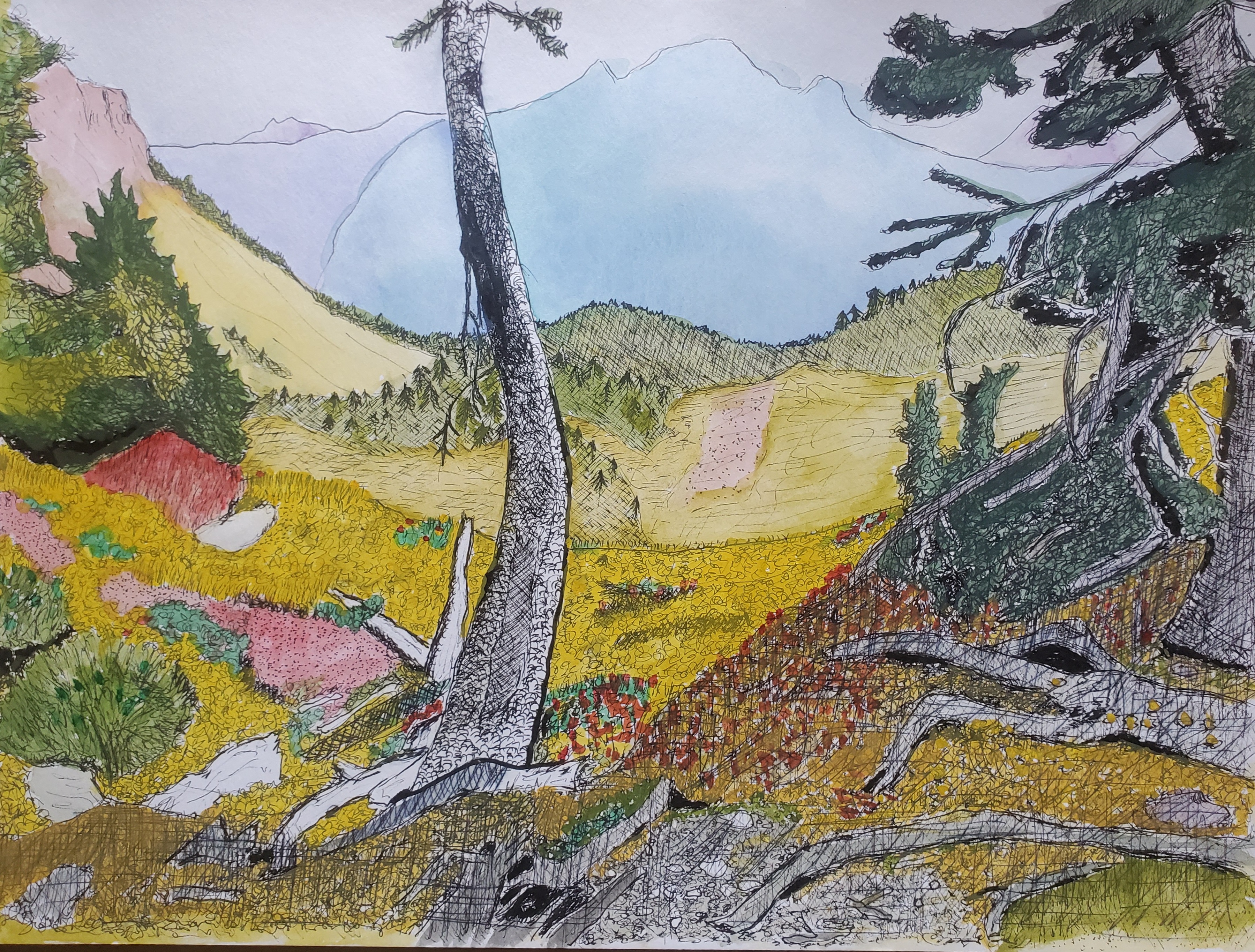
Covid has delayed production of Totem for a year, which is fine, because during these months of isolation and home-bound-ness I have returned to a feeble hobby I enjoyed greatly decades ago, drawing sketches. This year, too, has been a chance to get back into the mountains for hiking, but these days I am slower, and tend to spend fewer hours a day under a pack, walking, leaving time to stop, observe, and draw whatever I see along the way. It used to be, for years, the definition of a decent hike was how blown you were at the end, how damaged, how great the pain, but age, while not removing the pain, has at least allowed enough small wisdom to be a little more conservative. Your scribe was never the brightest bulb in the room. So, hence, I have taken to drawing along the way, with pencil, or ink, small 5 inch square heavy paper sheets, easy to store in a back pack. The drawings are feeble, primitive, and reveal an unsettling mind, but they have been fun. My wife suggested, when I came back from one such hike last spring, perhaps I could draw a story with these panels, share it with our small tribe of grandchildren and nieces and nephews, or grand-nieces and nephews. This seemed like a fine idea, and so I did so, with the idea I could have a Zoom meeting with the widely scattered wee ones and tell the story in real time over the screen. Then, to increase their anticipation, my wife suggested that maybe I could send a story panel, once completed and copied, to each of the kids so when they watched the story then could also be holding part of it in their hands, waiting then to see where it fell in the tale.

This I did. It was (and is) a lot of work, hours, but great fun. I took heavy watercolor paper and cut it to fit in business sized envelopes, then drew the panels and mailed them to the kids after photographing them on my phone, cropping them, and then storing them on my computer such that I could prepare a PowerPoint slide show, but a slide show of drawings, pictures, which I then can run through, live, on Zoom, telling the tale picture by picture. The first time we did the Zoom event I hadn’t even finished the first story, but it was a way to tell the kids and their parents, my own kids and cousins, what to expect, and to get them ready for the pictures appearing in their mailbox. It is also possible to record these Zoom events, which means, I can then take the recorded tale and get it up on You Tube and send that, too, to each wee one, such that they have the story to watch again if they wish, at their pace and speed, but also available for those kids who may be unable to make the Zoom meeting.

Years and years ago when my own kids were little, at Christmas I would buy a lot of cheap – I mean, CHEAP – little plastic figurines of animals and dinosaurs and monsters and wrap them, one apiece, to the kids who would be present, usually three or four kids and their cousins, and with each tiny present was a card upon which I wrote a 3×5 chapter of a tale, one by one, such that as the other presents were opened a story was being told to all the kids, involving them. This was something that was a much bigger success than I expected. Then, a bit later, I began telling stories to my son Jack to put him to bed, when he was very little, in a crib, still, and these stories were about a young lad named Roland and him finding a hollow in a tree which was a Well of Time, a way to go into the past. I told him many such stories,all of which he has forgotten, which is probably good because I believe I was inhaling back then.

Now, fast forward 35-45 years, and it is another generation of wee ones, everything on flat screens, everything provided, and due to this pandemic everyone desperate for new material. These new stories, drawn on paper, copied, then shown via Zoom and Powerpoint while narrating the tale, have been much liked by the wee ones, whose minds are perhaps s twisted as my own.

Then, in November, one of the kids, the oldest one, actually, Ollie, sends me a drawing he has made and says, maybe you can put this in your next story, and this seemed like a fine idea, so I solicited drawings from all the other kids, whatever they wished, and then drew a story which included their characters and drawings, too. This was even more work, but great fun, great fun.

So it seems that just as I have finished one series, the Strong Heart Series, three books about the Pacific Northwest, ancient history, an ornery young girl and her companions, I have now embarked on another: The Well of Time series. This blog post here was started years ago simply as a great place to store the stuff I enjoyed and had fun with, and if someone gets into it and enjoys it, fine. Now the Well of Time tales, those done so far, are on this blog too, just along the bottom of this site, available to anyone who wants to watch them.

When I finished Totem I knew I had completed the first series, in three tales. I suspect the Well of Time tales might carry on a bit longer. I would say, as far as the pandemic goes, there could have been many worse ways to pass the time.